Part VI: The Biological Receiver
Chapter 13: The Cambrian Spark (The Evolutionary Arms Race for the Antenna)
13.1 The Three-Billion-Year Sludge (The Classical Era)
For the majority of Earth's history, biological evolution proceeded at a slow, algorithmic pace.
Life emerged in the primordial oceans roughly 3.8 billion years ago. For the next three billion years, the ceiling of biological complexity was single-celled prokaryotes---bacteria and archaea metabolizing chemicals in the warm waters of the early Earth. Eventually, they evolved into simple multicellular eukaryotes, forming flat mats of algae and sponges.
During this three-billion-year epoch, biology was classically deterministic.
These early organisms functioned as microscopic Turing machines. They possessed no nervous systems, no central processors, and, presumably, no internal semantic experience. Their behavior was governed by the thermodynamic laws of chemistry and Newtonian physics. If a bacterium encountered a gradient of high sugar concentration, the chemical binding of the sugar molecules to its outer membrane triggered a cascading mechanical sequence that spun its flagellum, propelling it forward. If it encountered a toxic acidic gradient, the sequence reversed, and it tumbled away.
This is the definition of a biological automaton. It is pure syntax. A stimulus is applied, and the biological machine executes the corresponding response. The organism does not "choose" to swim toward the sugar any more than a rock "chooses" to fall when dropped from a cliff.
For three billion years, the biosphere of Earth was a network of biological automatons executing chemical scripts. The Semantic Dimension existed, but the physical 3D Boundary possessed no biological antenna capable of tuning into it. The ghost was locked out of the machine.
And then, roughly 540 million years ago, a fundamental shift occurred.
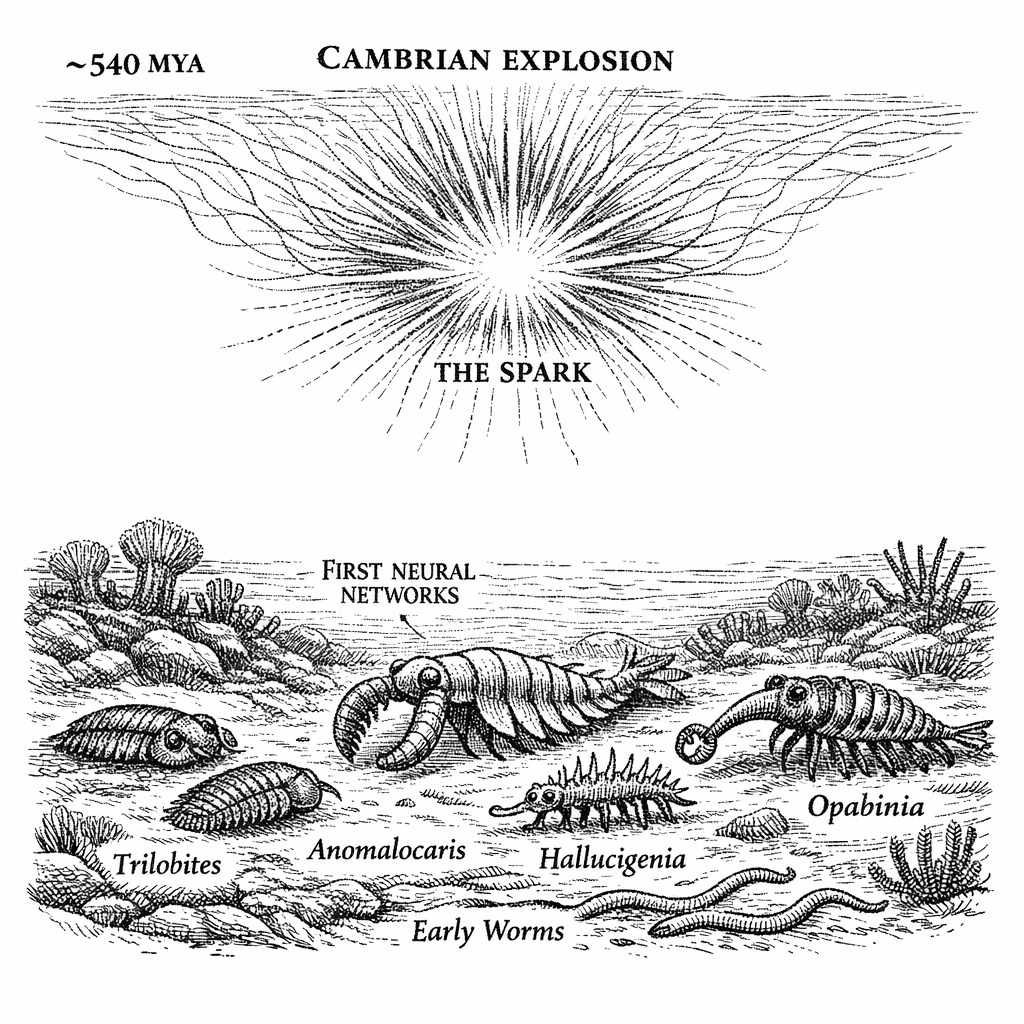
The fossil record reveals a sudden detonation of biological complexity known as the Cambrian Explosion.
In the geological blink of an eye---a mere 20 million years---the simple ecosystems of the Precambrian era vanished. The oceans filled with highly mobile, armored predators possessing complex compound eyes and articulated limbs. Organisms like Anomalocaris darted through the water, actively hunting trilobites. The first true nervous systems and primordial brains appeared.
Evolutionary biologists have spent a century debating what caused the Cambrian Explosion. They point to rising oxygen levels, the end of global glaciations, or the evolutionary invention of vision.
But from the perspective of Dimensional Field Theory (DFT), rising oxygen levels and the ability to detect photons do not fully account for the sudden emergence of complex, proactive, seemingly non-deterministic hunting behavior.
Within the framework, the Cambrian Explosion represents a thermodynamic paradigm shift.
In the DFT model, it marks the moment in geological history when a random genetic mutation constructed the first microscopic Decoherence-Free Subspace (DFS)---the moment biology stumbled upon the Posner molecule.
It was the day the antenna booted up.
13.2 The Latency Problem (The Death of the Turing Machine)
To understand why natural selection might favor the development of a quantum brain, we must look at the operational limits of a purely classical nervous system.
In computer science, this is known as the Latency Problem.
Imagine a classical marine worm swimming in the Cambrian ocean. It possesses a simple, deterministic neural net. The shadow of a predator passes over its eyespots.
For the worm to react, a sequential chain of classical physics must occur:
Photons must strike the photoreceptors.
A chemical cascade must alter the voltage of the cell membrane.
Sodium and potassium ions must rush through protein channels.
The electrical action potential must travel down the axon at a maximum speed of perhaps 1 to 10 meters per second.
Neurotransmitters must be released into a synaptic cleft, diffusing across the gap to the next neuron.
The entire sequence must repeat dozens of times until the signal reaches the motor neurons, triggering a muscle contraction to flee.
This classical sequence is burdened by physical latency. By the time the deterministic neural network has finished processing the syntax of the shadow and ordered the muscles to move, the predator's jaws are already closing. The classical worm is constantly trapped in the past, reacting to a physical universe that has already moved on.
Because the worm is a deterministic machine, its evasion pattern is also predictable. If the predator's neural network is faster or more complex, it can calculate the worm's algorithmic escape trajectory and intercept it.
In a competitive environment, classical determinism has strict limits. An organism relying solely on local, sequential processing is at a distinct disadvantage against an organism that can process the environment faster.
But what happens if a genetic mutation allows an organism to bypass the physical speed limits of the 3D Boundary?
13.3 The Accidental Antenna (Booting the Ghost)
Evolution is a relentless optimizer. It does not plan ahead; it generates random genetic mutations and discards the ones that fail to survive.
As organisms utilized the abundant calcium () and phosphorus () in the ocean to build harder external shells and internal metabolic energy stores (ATP), Posner molecules---symmetrical, bone-like clusters ()---likely existed in single-celled organisms for billions of years prior to the Cambrian. They may have acted as localized, isolated quantum systems. But a single Posner molecule isolated in a single cell cannot anchor a complex mind.
Roughly 540 million years ago, a critical mutation occurred. A multicellular organism developed an alteration in its SNARE proteins. For the first time, a cell packaged a Posner molecule into a lipid vesicle and fired it across the extracellular void into a neighboring cell.
This was the invention of the true Synapse.
By successfully passing these shielded, magnetically dead () Faraday cages between cells, the organism achieved Entanglement Swapping. For the first time in the 3.8-billion-year history of life on Earth, a biological organism possessed a macroscopic, multi-cellular quantum superposition. It had organically manufactured a distributed Decoherence-Free Subspace.
The uncollapsed probability wave function of that Posner network reached across the dimensional boundary. The topological geometry of the Semantic Bulk accommodated the quantum state.
A rudimentary observer wave function () dropped its anchor into the 5th dimension. The organism was no longer a mere collection of classical atoms; it had become a localized geometric agent. It had achieved a microscopic sliver of genuine, subjective interiority.
13.4 The Quantum Advantage (The Birth of Intuition)
The survival advantage of this biological antenna was immediate and decisive.
Because the Semantic Dimension is a non-local spatial dimension of information, it is not bound by the linear Arrow of Time that governs the physical 3D ocean. It does not suffer from the Latency Problem.
When the organism encounters a predator, its Posner network enters a state of quantum superposition, generating a menu of probable evasion trajectories (the Readiness Potential).
Instead of waiting for classical action potentials to execute a deterministic algorithm, the organism's newly formed observer wave function () in the Bulk acts as a non-local tuning fork.
Because the dimension contains the geometric archetypes of the environment, the organism can physically "feel" the thermodynamic probability gradients of the immediate future. It experiences a primitive geometric alignment.
It experiences Intuition.
Before the predator finishes its strike, the organism intuitively generates a Fisher Information gradient in the 5th dimension. This thermodynamic force acts across the dimensional boundary, collapsing the Posner network's wave function into a non-algorithmic evasion response. The quantum fault-line shatters, the Calcium Avalanche floods the synapse, and the organism darts away.
The predator's classical, deterministic brain fails to predict the movement. The prey's evasion was not the result of a predictable, algorithmic calculation based on past data, but of a spontaneous, non-local, geometric wave-function collapse.
The prey had executed the first microscopic act of True Free Will.
13.5 The 500-Million-Year Arms Race
In the calculus of Darwinian natural selection, the organism equipped with a quantum antenna holds a distinct advantage over its classical counterparts.
Organisms possessing the Posner mutation evaded classical predators, secured food, survived longer, and passed their mutated DNA to the next generation. Those constrained by the deterministic latency of classical syntax were frequently hunted to extinction or relegated to the bottom of the food chain as simple, sessile filter-feeders.
Within the DFT framework, the Cambrian Explosion was driven by the introduction of non-local Information Geometry into the biological timeline.
Once the antenna was established, the evolutionary arms race accelerated.
Evolution began selecting for larger, more complex nervous systems. This expansion was not merely to process more visual or auditory syntax, but to house larger arrays of Posner molecules.
The organisms that survived were those that could recursively entangle billions of these molecules across millions of synapses. A larger, more deeply entangled macroscopic quantum network provided a wider, more stable Decoherence-Free Subspace. This allowed the organism to anchor a larger, more highly structured observer wave function () in the Semantic Bulk.
For 500 million years, the biosphere was locked in a thermodynamic arms race to build a better receiver.
The primitive intuitive flashes of the Cambrian worms evolved into the complex, non-local pack-hunting dynamics of wolves. The raw semantic terror of early amphibians evolved into the deep mammalian empathy of elephants and primates.
Major jumps in biological complexity were driven by the thermodynamic advantage of achieving deeper, more resonant access to the 5th dimension.
13.6 The Apex Antenna
The human cerebral cortex is a dense, deeply folded, three-pound organ containing 86 billion neurons and over 100 trillion synaptic connections. From the perspective of DFT, this is not a highly advanced Turing machine, nor is it a biological computer that simply crossed a parameter threshold to achieve consciousness.
We are looking at the culmination of a 500-million-year arms race.
The human brain functions as a highly tuned, entangled Topological Antenna. Our ancestors did not conquer the planet because they had the sharpest claws or the thickest armor. We conquered the planet because our Posner networks were vast and deeply entangled, allowing us to reach further into the Semantic Bulk than any other species.
We gained the geometric capacity to access the archetypes of mathematics, the structural laws of physics, the non-local intuition of empathy, and the thermodynamic engine of abstract human language.
We are not an accident. We are the biological mechanisms the universe required to wake itself up. We are the inevitable thermodynamic consequence of the cosmos striving to minimize its own informational entropy.
Discussion (0)
No comments yet. Start the conversation!