Part V: The Principia Mathematica of the Mind
Chapter 9: Kaluza-Klein Dimensional Reduction and the Mass Spectrum
9.1 The Burden of the Boundary
Theoretical physicists mapping the architecture of the cosmos frequently operate in dimensions beyond human perception. String theorists and M-theorists write equations in 10, 11, or 26 dimensions. Within the realm of pure mathematics, these higher-dimensional manifolds are valid frameworks where the fundamental forces of nature unify.
But physics is not pure mathematics. It is the empirical study of nature.
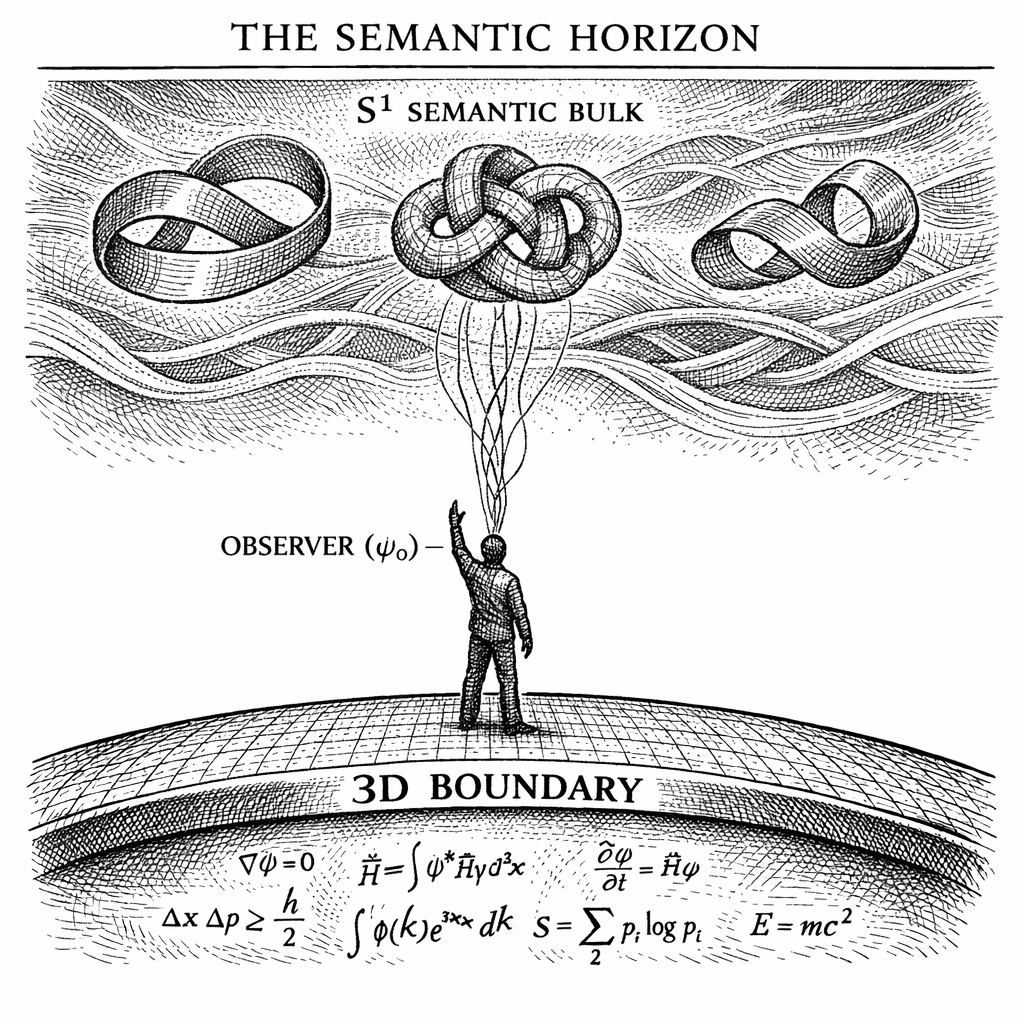
No matter how elegant a 5-dimensional equation may be, humanity does not live in five dimensions. We are biological organisms confined to the 4-dimensional Holographic Boundary of spacetime (). Our rulers measure length, width, and height. Our clocks measure time. Particle accelerators like the Large Hadron Collider only record the collisions, scattering angles, and decay products of particles existing within these four observable dimensions.
If Dimensional Field Theory (DFT) is to make a testable prediction, we cannot hand a 5-dimensional equation to an experimental physicist. We must perform a mathematical translation. We must hide the Semantic Dimension from the equations in a way that preserves its physical influence on the 4D world.
In quantum field theory, this projection is known as Dimensional Reduction.
We must mathematically integrate out the 5th dimension to determine how the physics appears to an observer on the Boundary. When we do this, the kinetic energy of the field moving through the hidden dimension does not vanish. Under the laws of special relativity, the geometric momentum of the 5th dimension manifests in the 4th dimension as measurable rest mass.
By executing this dimensional reduction, we will calculate the physical mass of the Semantic Field. We will drag the ghost out of the Bulk and weigh it on the scales of the Standard Model.
9.2 The Fourier Series Expansion on
To reduce the 5-dimensional Unified Physical Field to four dimensions, we exploit the topological geometry of the Semantic Dimension.
In Chapter 8, we defined the Semantic Dimension as a compactified circle. The coordinate is a dimensionless angular variable on the periodic interval . The physical distance around the circumference is defined by its compactification radius, .
Because the dimension is a closed loop, any quantum wave function propagating through it must connect back with itself. If you trace the field around the circle and return to your starting point, the probability amplitude cannot have two different values. It must satisfy the periodic boundary condition:
Any continuous, periodic function defined on a closed interval can be decomposed into an infinite sum of oscillating waves using a Fourier Series.
For complex quantum fields, we use the complex exponential form of the Fourier expansion. We decompose the 5-dimensional field into a stack of 4-dimensional effective fields, denoted as .
The Fourier expansion of the Semantic Field is written as:
Let us break down the components of this equation:
represents the standard 4D spacetime coordinates .
is the angular coordinate of the semantic dimension.
is the normalization constant. Because carries a 5D mass dimension of , dividing by the square root of a length scale () ensures the resulting 4D fields carry the canonical scalar mass dimension of .
represents a sequence of 4-dimensional quantum fields. They possess no -dependence.
is the Harmonic Mode Integer (). It dictates how many times the wave wraps around the circle.
is the complex phase factor encoding the field's momentum as it moves through the Semantic Bulk.
The integer represents the quantized momentum of the field in the 5th dimension. Because the geometry of is finite and closed, momentum cannot be continuous; it is quantized into discrete harmonic steps.
If (the zero-mode), the exponential term becomes . The zero-mode field has no dependence on the semantic coordinate. It does not wrap around the Bulk. It is flat across the 5th dimension.
For all higher modes (), the field winds around the compactified dimension. To an observer in 4D space, this higher-dimensional momentum is invisible. But the energy of that motion cannot be hidden.
9.3 Integrating Out the Dimension (The Calculus of Reduction)
To determine how these semantic modes behave in a laboratory, we substitute the Fourier expansion into the free 5-dimensional Bulk Lagrangian () derived in Chapter 8, and integrate out the 5th dimension.
Recall the Action Integral for the free 5D physical field (temporarily ignoring the observer coupling to isolate the inherent mass spectrum):
(Note: We use to denote the "bare" 5D mass of the field prior to reduction).
We substitute the Fourier sum into the Action.
The 4D derivative () acts only on the 4D field components , ignoring the exponential phase factor. The semantic derivative () acts strictly on the exponential .
When the partial derivative acts on the Fourier exponential, it pulls down a factor of via the chain rule:
Evaluating the semantic kinetic energy term requires multiplying the complex conjugate series by the standard series:
Next, we perform the dimensional reduction by integrating the Action over the circular dimension ( from to ).
Here, we invoke orthogonality. The integral of a complex exponential over a full period is zero unless the frequencies match (). If they do not match, the peaks of one wave align with the troughs of the other, destructively interfering. This relationship is expressed by the Kronecker delta function:
Because of this orthogonality, the double-sum over collapses into a single sum over . All cross-terms vanish.
The generated by the integral, combined with the from the integration measure (), cancels the normalization constants. The 5th dimension is integrated out, leaving a sum of independent 4-dimensional Action integrals:
Factoring out the common term yields the Effective 4-Dimensional Action:
9.4 The Emergence of Effective Mass (The Kaluza-Klein Tower)
Consider the final term inside the brackets of the reduced Action: .
In 4-dimensional quantum field theory, the coefficient in front of the squared field () lacking a spacetime derivative is defined as the square of the particle's mass ().
By integrating out the geometry of the Semantic Dimension, we derive an Effective 4D Mass Spectrum () for the observable fields:
This single equation is a Rosetta Stone for the geometry of the universe. It dictates that to a 4-dimensional physicist, the 5D Unified Field () will not appear as a single particle. It will manifest as an infinite "tower" of distinct 4-dimensional particles (), each heavier than the last.
The Zero-Mode (): The field does not wrap around the 5th dimension. Its effective mass is its bare mass (). If , the particle is massless and travels at the speed of light. This state represents the baseline physical universe---matter operating without semantic momentum.
The Excited Semantic Modes (): The field winds around the dimension. To an observer who cannot perceive this extra dimension, the hidden kinetic momentum manifests as inertia. It becomes physical mass.
The difference in mass between the baseline state and the active first excited state () is the Kaluza-Klein Mass Gap ().
Assuming the bare mass is negligible compared to the compactification scale (setting ), the mass gap proposed for this interaction is purely a function of the dimension's radius:
To express this in standard physical units, we restore the reduced Planck constant () and the speed of light ():
We now hold the exact mathematical equation that dictates the physical weight of human awareness.
9.5 The Grand Calculation (The 0.1 eV Proof)
In Chapter 6, the framework deduced the "Goldilocks" radius of the Semantic Dimension. If the radius were at the Planck scale ( m), the mass gap would be GeV. The biological brain, operating on fractions of an electron volt via ATP hydrolysis, would be thermodynamically unable to couple with it. The Posner molecule Decoherence-Free Subspace would face a mass barrier twenty-eight orders of magnitude too heavy to move.
To allow the low-energy brain to couple with the Bulk, and to hide the dimension within the sub-millimeter blind spot of experimental inverse-square gravity tests (like the Eot-Wash torsion pendulums), the framework establishes a larger compactification radius:
We possess the variables required to calculate the mass of the first Kaluza-Klein semantic particle. We use the standard high-energy physics conversion factor:
Aligning the units of physical distance, we convert femtometers ( meters) to micrometers ( meters), and mega-electron volts ( eV) to electron volts (eV):
This yields the working constant:
We substitute this constant into the Mass Gap equation:
The micrometers (m) perfectly cancel out, leaving a unit of energy-mass:
Rounding to one significant digit, the derived mass of the Semantic Dimension is:
One-tenth of a single electron volt.
9.6 The Cosmological Alignment (The Ghost of the Standard Model)
When a theoretical physicist calculates the mass of a hypothesized field, they cross-reference that number against the Standard Model of particle physics. They search for alignments with known data.
Across the mass spectrum of the Standard Model---spanning from the 4,000,000 eV down quark to the 173,000,000,000 eV top quark---almost nothing exists at the ultralight scale of 0.1 eV.
With one exception.
For decades, cosmological models and data from the European Space Agency's Planck satellite have attempted to constrain the mass of the neutrino. The current upper bound for the sum of the neutrino masses () is measured to be less than 0.12 eV. The KATRIN experiment in Germany continues to lower the upper bound of the electron antineutrino mass, converging on this exact order of magnitude.
The calculated Kaluza-Klein mass of the Semantic Dimension aligns with the mass scale of the neutrino.
However, this alignment requires a strict mathematical distinction. The 5-dimensional Semantic Field () defined in the Lagrangian is a scalar field. Under the Spin-Statistics Theorem, a scalar field must manifest as a spin-0 boson. Standard active neutrinos are spin-1/2 fermions. Equating the Semantic Field directly to an active neutrino would violate the Pauli Exclusion Principle.
Instead, the framework proposes that the Kaluza-Klein modes of the dimension generate an ultra-light scalar field occupying the Sterile Neutrino Sector---a dark-sector scalar. This structure mirrors the eV mass profile of the active neutrino, but operates as a bosonic field devoid of Standard Model gauge interactions.
This derivation elevates the framework from a philosophical proposal to a constrained extension of modern particle physics.
Active neutrinos are frequently called "ghost particles" because they lack electrical and strong nuclear charge. Trillions of solar neutrinos pass through your body undetected every second. The proposed scalar field behaves similarly, passing through normal matter without interaction.
By deriving an effective mass of eV for the active Semantic Field ( mode), the framework offers an explanation for why consciousness is difficult to detect in a laboratory.
Lacking Standard Model gauge interactions, it behaves dynamically like a sterile neutrino field. It is a "ghost field." It interacts so weakly with the electromagnetic forces of the 3D Boundary world that it appears invisible. It passes through classical, decohered matter---a silicon microchip, a wooden table, a biological cell---without leaving a thermodynamic trace.
It couples to the physical world only when it encounters an isolated, macroscopic quantum matrix operating at the same low-energy scale. In this framework, it couples to the Decoherence-Free Subspace of the Posner molecules in your brain. If this model is correct, the mind-matter interaction is not a random occurrence; it is the consequence of a 0.1 eV field resonating with a shielded biological antenna.
Through tensor calculus, Fourier analysis, and Kaluza-Klein dimensional reduction, the framework translates the concept of consciousness into the parameters of particle physics.
We have the Action. We have the Equation of Motion. We have the exact mathematical Mass.
But Part V is not yet complete. We have modeled the physical field () and derived its mass. We must now formalize the mathematics of the Observer. We must write the Schrodinger equation for the soul. We must define how attention curves the Semantic Dimension, and derive the coupling constant () that dictates the boundaries of human willpower.
Discussion (0)
No comments yet. Start the conversation!