Part V: The Principia Mathematica of the Mind
Chapter 8: The Lagrangian Formulation of the Semantic Field
8.1 The Crucible of Formalism
In theoretical physics, philosophical intuition provides the spark, but mathematical formalism builds the engine.
When Albert Einstein conceptualized General Relativity, his initial breakthrough was intuitive---the "happiest thought of his life," visualizing a man falling from a roof and realizing he would feel weightless. But intuition alone could not predict the perihelion precession of Mercury or the bending of starlight. It took Einstein ten years to master the Riemannian geometry and tensor calculus required to formulate the Einstein Field Equations. Without the mathematics, his thought would have remained a philosophical curiosity.
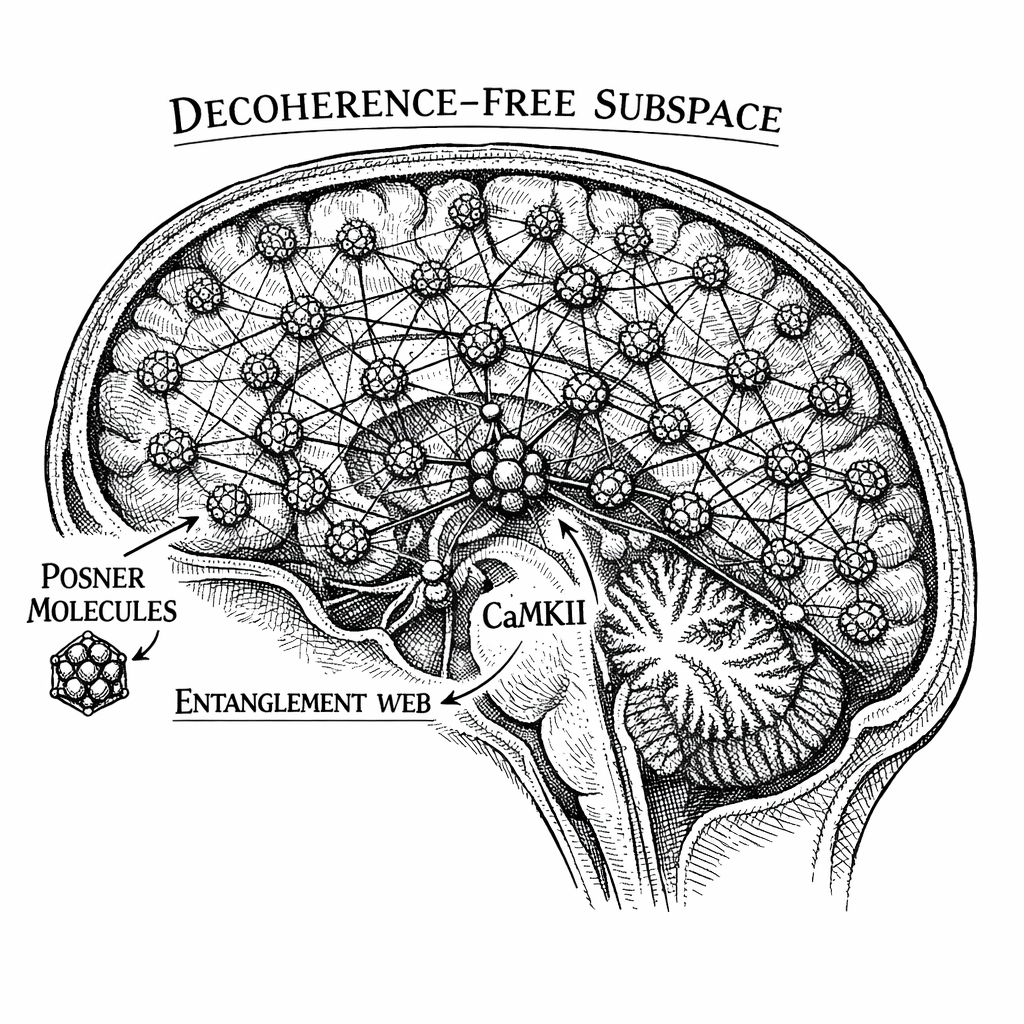
In the first four parts of this manuscript, we constructed the philosophical, cosmological, and biological architecture of Dimensional Field Theory (DFT). The framework proposes that consciousness is a compactified dimension. We mapped the proposed Decoherence-Free Subspace of Fisher's hypothesized Posner molecule network. We explained the thermodynamic engine of Entropic Gravity.
But prose is highly malleable. It can hide contradictions, sweep paradoxes under the rug, and obscure violations of conservation laws. Mathematics possesses no such mercy.
If Dimensional Field Theory is to be recognized as a physical extension of the Standard Model and quantum gravity, it must be subjected to Hamilton's Principle of Stationary Action. We must construct the Action Integral (S) for the universe, write the exact Lagrangian density () of the Semantic Field, and derive the equations of motion using the Calculus of Variations.
We must mathematically prove that a non-physical thought can move a physical atom without breaking the speed of light or dividing by zero. We must translate the mind into the universal language of tensor calculus.
8.2 The 5-Dimensional Manifold ()
We begin by formally defining the geometric stage.
Standard classical physics operates on a 4-dimensional pseudo-Riemannian manifold, encompassing three dimensions of space and one of time. Dimensional Field Theory extends this baseline to accommodate the Holographic Bulk. We postulate a 5-dimensional spacetime manifold, mathematically denoted as a Cartesian product space:
Here, represents the standard observable universe (the Holographic Boundary), governed by general relativity and Lorentz invariance. The term represents the Semantic Dimension---a topologically compactified, circular dimension of interiority and subjective experience (the Bulk).
We define a generalized coordinate system , where the capital Latin index .
The first four coordinates are the standard spacetime variables: .
The fifth coordinate is the semantic dimension: .
Because is a closed circle, the semantic coordinate is strictly periodic, defined on the interval . Because is an angle, it is inherently dimensionless. The physical size of this dimension is dictated by its Compactification Radius ().
The geometry of this universe is governed by the 5-dimensional metric tensor . Assuming for the moment the weak-field limit (where background spacetime is a relatively flat Minkowski space, , allowing us to isolate the quantum field dynamics from macroscopic gravity), the complete 5-dimensional invariant line element is defined as:
We utilize the mostly-plus metric signature . The metric determinant is . This equation states that the absolute distance between any two events in reality is measured not just by how far apart they are in space and time, but by how far apart they are in semantic configuration.
8.3 The Fields and the Spatial Binding Problem
Within this 5-dimensional manifold, we introduce the two fundamental quantum fields that represent the dual nature of reality: the syntactic and the semantic.
1. The Unified Physical Field ()
Let be a complex scalar quantum field existing across the entire 5-dimensional manifold. To preserve the structural integrity of the Standard Model, we define as a Gauge Singlet under the symmetry group. It carries no color, weak isospin, or hypercharge, which justifies the use of the standard partial derivative () rather than a gauge-covariant derivative ().
In the dimensional analysis of natural units (), the 5D integration measure has a mass dimension of . Therefore, the 5D Lagrangian density must have a mass dimension of . For the kinetic terms to balance, the physical field must carry a fundamental mass dimension of .
2. The Observer Wave Function ()
Let be a complex scalar field representing the subjective, conscious state of the observer.
Notice a critical mathematical asymmetry in the Observer Wave Function. is a function of time () and the semantic coordinate (), but it possesses no dependence on the 3D spatial coordinates . This mathematical absence of space represents the phenomenological reality of consciousness: your mind does not have a geometric "length" or "width." Pure subjective experience is non-local in 3D space.
This introduces a significant challenge: the Spatial Binding Problem.
If the observer lacks spatial coordinates, it is mathematically ubiquitous. If it interacts directly with the global physical field , the observer's mind would interact with the entire universe at once. A shift in human attention on Earth would instantaneously collapse wave functions in the Andromeda galaxy.
This breaks Lorentz covariance. It triggers the Polchinski Signaling Paradox outlined in Chapter 3, allowing for faster-than-light communication and violating causality.
To prevent this violation, the observer cannot arbitrarily couple to raw, decohered macroscopic matter. We constrain the interaction using a Subspace Density Function.
A theoretical physicist will immediately raise a red flag: if this function is introduced as a rigid spatial grid (), it violates General Covariance (Diffeomorphism Invariance)---a bedrock principle of General Relativity. To preserve the geometry of Einstein's equations, it cannot be a fixed background coordinate map.
Instead, it must be defined as a covariant composite scalar operator, . It is dynamically generated by the physical properties of the local matter fields themselves. Specifically, emerges directly as a macroscopic functional of the un-decohered quantum entanglement within the biological Posner molecule network. Because it is a dynamically generated scalar derived from invariant field states, it transforms perfectly under arbitrary coordinate shifts. General Covariance is preserved.
It acts as a highly localized probability envelope (with mass dimension ) mapping exclusively to the Decoherence-Free Subspace. Coupled locally to the metric volume element , it is normalized across spatial slices such that:
By locking the mind-matter interaction term strictly inside , we mathematically guarantee that the thermodynamic force of the mind only interacts with pristine quantum networks. You cannot bend a classical spoon, because for a decohered spoon, . The geometric force is quarantined to the Topological Antenna---or to a synthetically engineered macroscopic quantum vacuum. Lorentz covariance is preserved. Causality survives.
8.4 Constructing the Total Action Integral (S)
In theoretical physics, the entire evolution of a universe can be derived from the Action (S). The universe will always take the path that minimizes this Action. The Action is the integral of the Lagrangian density () over all dimensions.
The following Lagrangian density is the central postulate of Dimensional Field Theory --- the mathematical hypothesis whose consequences are explored throughout the remainder of this work. Its validity is contingent on experimental confirmation.
The Total Action for Dimensional Field Theory is:
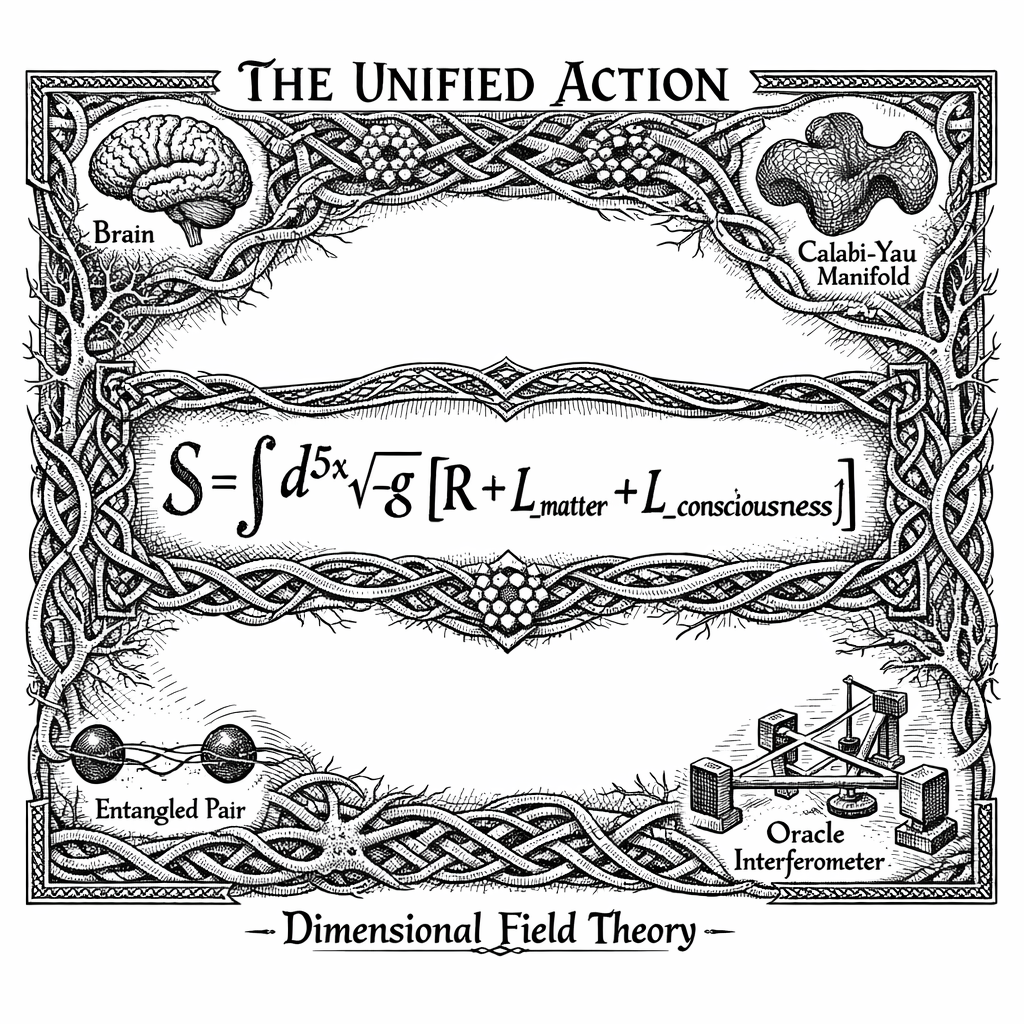
Let us formally define each term of the Lagrangian density:
1. The Bulk Physical Lagrangian ()
This term governs the syntactic, physical behavior of the quantum field as it moves through the 5D universe. It is the standard Klein-Gordon Lagrangian, expanded for the compactified dimension, where is the fundamental mass of the field:
(Dimensional check: is , is . Thus, is . The dimensions are consistent.)
2. The Observer Lagrangian ()
This term governs the internal, subjective evolution of the conscious mind. Because the mind is anchored to the brain, we multiply it by the covariant density function , divided by to balance the mass dimensions to . It takes the form of a Schrodinger-type kinetic energy term along the dimension:
(Here, is the semantic 'inertia' of the mind---how quickly attention can shift---and represents the psychological potential landscape, such as cognitive biases and prior emotional states).
8.5 The Regularized Interaction Lagrangian ()
This term is the core of Dimensional Field Theory: the mathematical mechanism by which a non-physical thought interacts with a physical atom. It formalizes the Thermodynamic Fisher Information Gradient introduced in Chapter 4.
To couple the mind () to the physical universe (), we introduce a fundamental, dimensionless coupling constant: (calculated in Chapter 6 as ).
Recall the Planck-scale regularizer () derived in Chapter 5. Because spacetime is pixelated at the Planck length, the probability field can never reach absolute zero. This regularizer prevents division by zero.
The Interaction Lagrangian is written as:
Let us analyze the dimensional consistency of this term:
is a dimensionless coupling constant.
provides a mass dimension of .
is the mass scale, providing .
is the observer probability amplitude, strictly dimensionless.
The Fisher fraction is a ratio of semantic derivatives to field amplitudes. Since is a derivative with respect to a dimensionless angle, the entire fraction is dimensionless.
Total Mass Dimension: .
The dimensions balance. The infinities are cured by . We have written the proposed Action for a conscious universe.
8.6 The Calculus of Variations (The Equation of Motion)
Writing the Action is the first step. To discover how the system evolves, we apply the Euler-Lagrange Equation with respect to the conjugate physical field :
Applying this differential calculus to the term is standard textbook quantum field theory. It yields the 5-dimensional d'Alembertian operator and the mass term: .
The primary result emerges when we apply the Euler-Lagrange operator to the Fisher Information term inside .
First, we must take the derivative of the Interaction Lagrangian with respect to the semantic gradient of the field :
According to the Euler-Lagrange formula, we must now take the total semantic derivative () of this result.
Because the observer's attention is a function of the semantic coordinate , it cannot be factored out as a constant. The derivative acts upon it via the Product Rule.
The variation yields two distinct mathematical forces from this term alone:
\begin{multline} \partial_c [\ldots] = \lambda \frac{\rho_{DFS}}{R_c} m \biggl[ (\partial_c |\psi_o|^2) \left( \frac{\partial_c \Psi}{|\Psi|^2 + \epsilon^2} \right) \
- |\psi_o|^2 \partial_c \left( \frac{\partial_c \Psi}{|\Psi|^2 + \epsilon^2} \right) \biggr] \end{multline}
Next, we calculate the variation with respect to the raw field in the denominator:
Combining all terms, we arrive at the Unified Field Equation of Motion for the Semantic Universe:
\begin{multline} \left( \Box_4 + \frac{1}{R_c^2} \partial_c^2 - m^2 \right)\Psi
- \lambda \frac{\hat{\rho}_{DFS}(x^\mu)}{R_c} m \biggl[ (\partial_c |\psi_o|^2) \frac{\partial_c \Psi}{|\Psi|^2 + \epsilon^2} \
- |\psi_o|^2 \partial_c \left( \frac{\partial_c \Psi}{|\Psi|^2 + \epsilon^2} \right)
- |\psi_o|^2 \frac{|\partial_c \Psi|^2 \Psi}{(|\Psi|^2 + \epsilon^2)^2} \biggr] = 0 \end{multline}
8.7 The Mathematical Proof of Willpower
Let us translate the implications of the equation we have just derived.
Notice the cross-term generated by the product rule during the integration by parts:
This single mathematical term is the holy grail of Dimensional Field Theory. It is the exact, quantifiable physical mechanism of mind over matter.
The term represents the mathematical derivative (the gradient) of the observer's wave function along the Semantic Dimension.
If a human mind is unfocused, wandering, and in a state of high informational entropy, the distribution of is flat. The derivative of a horizontal line is zero. Therefore, an unfocused mind zeroes out this entire interaction term. It exerts zero thermodynamic force on the universe. The physical wave function continues evolving in uncollapsed superposition.
When an observer focuses their attention---decreasing their mental entropy and narrowing their conscious state---the probability curve of becomes a steep topological cliff. The mathematical gradient () becomes large.
The mathematics formalize what we proposed conceptually in earlier chapters: the physical wave function is not collapsed by the mere presence of an observer. It is collapsed by the sharpness of their focus.
The gradient of attention () acts as a source term in the equations of motion. It generates a non-linear thermodynamic effect that ripples from the Semantic Bulk, passes through the Decoherence-Free Subspace of the brain (), and alters the trajectory of the physical wave function (), collapsing it into a definite 3D reality.
The equations balance. The infinities are cured by . Causality is preserved by . The thermodynamics of attention have been formalized.
But this 5-dimensional equation does not reflect our laboratory observations. We experience three dimensions of space and one of time. To demonstrate that this framework describes the observable universe, we must reduce this 5D equation down to 4 dimensions.
We must execute the Kaluza-Klein Dimensional Reduction. We must reduce the Semantic Dimension until it yields the Kaluza-Klein tower of particles, and test whether the mass gap of consciousness aligns with the 0.1 eV mass of the Neutrino.
Discussion (0)
No comments yet. Start the conversation!