Part V: The Principia Mathematica of the Mind
Chapter 10: Information Geometry and the Derivation of λ
10.1 The Architecture of Willpower
In Chapter 8, we applied Hamilton's Principle of Stationary Action to Dimensional Field Theory (DFT). We constructed the 5-dimensional Action Integral for the universe and executed the calculus of variations to derive the Unified Field Equation of Motion.
In doing so, we formalized the central interaction of the framework. When the Euler-Lagrange operator is applied to the Fisher Information term of the Lagrangian, the calculus product rule generates a specific cross-term:
This mathematical expression represents the proposed physical mechanism of mind over matter.
It dictates that the physical wave function () is driven by the gradient () of the observer's attention () along the Semantic Dimension. An unfocused mind (a flat probability curve) exerts zero thermodynamic force. A focused mind (a sharp topological cliff) generates a thermodynamic source term that drives the local physical universe to collapse into a definite 3D reality.
We have formalized the thermodynamics of attention.
However, a fundamental variable remains undefined. Sitting at the front of the interaction term, governing the physical strength of this process, is the dimensionless coupling constant: .
In the Standard Model of particle physics, coupling constants dictate how strongly different fields interact. The fine-structure constant () governs electromagnetism, determining how tightly electrons bind to atomic nuclei. The strong coupling constant () dictates the force binding quarks together inside a proton. Gravity is governed by a coupling constant so small () that a standard refrigerator magnet can overcome the gravitational pull of the Earth.
If Dimensional Field Theory (DFT) is correct, represents the fundamental limit of human willpower. It determines how much physical force a semantic state can exert on the 3D Boundary of the universe.
If were too large (e.g., ), human attention would wield the equivalent power of the strong nuclear force. A passing thought could trigger nuclear fusion or levitate a boulder. Everyday macroscopic reality would be highly unstable, reacting constantly to the subconscious processing of biological organisms.
If is exactly zero, Cartesian dualism is mathematically excluded. Conscious experience becomes an epiphenomenon generated by a deterministic biological machine, possessing no independent causal power over physical reality. We are philosophical zombies.
Dimensional Field Theory requires to be greater than zero, but exceptionally small. As we will explore in Chapter 21, designing a macroscopic optical interferometer experiment to overcome Poisson shot noise using a Watt-class laser requires searching for an anomaly at the scale.
In theoretical physics, however, fundamental constants cannot simply be assigned to make an experiment viable. A unified framework must derive its constants from the geometry of spacetime and the established masses of the Standard Model.
To calculate the strength of this interaction, we introduce a branch of modern mathematics: Information Geometry.
10.2 The Shape of Probability (Information Geometry)
In 1915, Albert Einstein demonstrated that gravity is not a pulling force, but the geometric curvature of spacetime. Massive objects warp the pseudo-Riemannian manifold of the universe, and objects travel along the straightest possible lines (geodesics) through that curved space. The metric tensor, , defines the shape of this curvature.
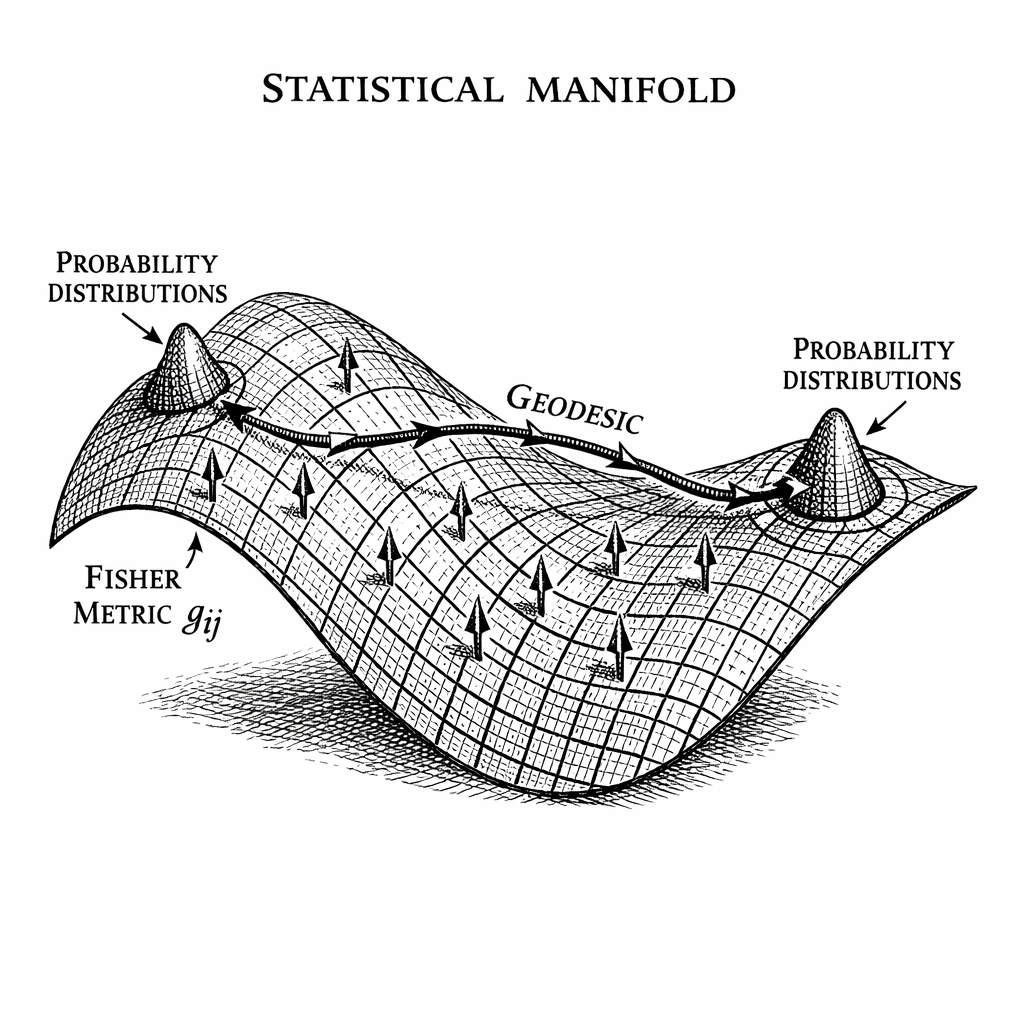
In the 1980s, mathematician Shun-ichi Amari applied this geometric logic to the realm of statistics and probability [1]. Amari showed that probability distributions do not merely sit on a flat mathematical graph. They form curved, multi-dimensional geometric spaces known as Statistical Manifolds.
Amari demonstrated that the Fisher Information Matrix---the statistical tool we used in Chapter 4 to define the thermodynamic force of attention---is more than a metric for calculating error bounds.
In Information Geometry, the Fisher Information Matrix serves as the Riemannian metric tensor () of the statistical manifold.
This equation implies that the mathematical distance between two states of mind (two probability distributions) is a geometric distance.
When your mind is unfocused and in a state of high informational entropy, your observer wave function () is spread flat across the Semantic Dimension. When you focus your attention on a single task, you decrease your entropy, narrowing your probability distribution into a sharp spike.
According to Information Geometry, you have not merely changed a statistical variable. You have traversed a geometric distance across the Semantic Bulk. By concentrating your probability distribution, you curve probability space.
Just as mass curves 4D spacetime to create physical gravity, the framework proposes that a focused mind curves the Semantic Manifold to create informational gravity.
The mind does not reach out to mechanically push physical atoms---the classical assumption of Cartesian dualism. Instead, focused attention alters the underlying geometry of probability. The physical wave function () acts as a marble rolling across a topological landscape. When the mind focuses, it warps the dimension, creating a thermodynamic gravity well. The wave function naturally rolls down the geodesic into a collapsed, definite state.
But how deep is this gravity well? How much does the Semantic Bulk influence the 3D physical Boundary?
To answer this, we must compare the fundamental mass scale of the Semantic Dimension with that of the physical dimension to calculate the Mass Ratio.
10.3 The Baryonic Anchor and the Mass Ratio
In unified field theories, dimensionless coupling constants frequently arise as mathematical ratios between competing mass scales. To derive , we must identify the two anchors engaged in this thermodynamic interaction.
On one side is the semantic field operating in the Bulk. In Chapter 9, using Kaluza-Klein dimensional reduction, we calculated that the active semantic field (the first excited harmonic mode, ) possesses a mass gap:
This 0.1 eV field (aligned with the cosmological mass limit of the neutrino) represents the proposed energy scale of the semantic dimension. It is ultra-light and delicate.
On the other side of the equation is the 3D Holographic Boundary---the decohered, macroscopic physical world.
What is the foundational mass scale of this physical 3D universe?
Over 99.9% of the mass of the everyday physical world---the stars, the planets, the chair you are sitting on, and the biological cells in your brain---is composed of baryonic matter. Baryons are composite particles made of quarks, bound together by the strong nuclear force (Quantum Chromodynamics, or QCD).
The foundational anchor of baryonic matter is the proton.
The mass of a single proton () is a defining constant in the physical universe, dictating the gravity of stars and the stability of matter.
To align our units, we convert mega-electron volts to standard electron volts:
(Roughly one billion electron volts).
We now have two fundamental mass anchors: the mass of the Semantic Dimension (0.1 eV) and the mass of the Physical Dimension ( eV).
The dimensionless coupling constant () represents the geometric fraction of the Semantic Bulk's energy relative to the inertial baryonic anchor of the physical Boundary. It is the thermodynamic ratio of the ghost to the machine.
10.4 The Baryonic Anchor Ansatz
In the absence of a fully unified theory of quantum gravity, deriving dimensionless coupling constants from first principles remains an unsolved problem. To define the coupling constant (), Dimensional Field Theory proposes a phenomenological ansatz.
The framework postulates that the thermodynamic coupling is governed by the ratio of these energetic anchors. We take the geometric ratio of the active Semantic Bulk ( eV) relative to the inertial anchor of the physical 3D Boundary, the proton ( eV).
We set up the ansatz for the coupling constant:
The units of electron volts (eV) cancel out, leaving a dimensionless geometric ratio:
While this ansatz requires experimental validation from the Oracle, it provides a bounded, falsifiable parameter space for empirical testing.
The proposed strength of the mind-matter coupling interaction is one part in ten billion.
Consider the alignment of this derivation.
As we will explore in Chapter 21, working from the perspective of optical metrology and the statistical limits of Poisson shot noise, detecting this targeted interaction requires finding an anomaly at the scale. The Mach-Zehnder Squeezed-Light Interferometer blueprint is designed specifically to reach this mathematical floor.
Operating from the independent principles of Information Geometry, Kaluza-Klein reduction, and the rest mass of the proton, the framework generates the same number.
The parameters of the theory are mathematically interlocked. The physics of the Bulk yields the experimental parameters required on the Boundary.
But what does mean for the human experience?
10.5 The Physics of the Poltergeist (Why Telekinesis Fails)
A coupling constant of one part in ten billion is exceptionally weak. It is ten billion times weaker than the strong nuclear force that holds a single atom together, and vastly weaker than the electromagnetic force binding a water molecule.
This mathematical weakness defines the physical limits of human consciousness, explaining why macroscopic telekinesis fails.
If you attempt to move a pencil resting on a desk through conscious focus, you will fail. A pencil is a macroscopic object containing roughly strongly bound baryonic atoms. The electromagnetic and gravitational forces anchoring that pencil to the desk are massive.
When your mind focuses, generating a Fisher Information gradient in the Semantic Bulk, the resulting thermodynamic force () acts upon the quantum wave function of the pencil. But the force is ten billion times too weak to overcome the macroscopic bonds of the wood and graphite. The thermodynamic influence of attention is instantly dissipated by the thermal noise of the 3D Boundary. Macroscopic telekinesis is a mathematical impossibility.
The ghost cannot move the mountain.
But the ghost can move a single, isolated quantum system.
If you apply a force of to a classical object, nothing happens. But if you apply a force of to an isolated quantum superposition---like a photon balancing in a Mach-Zehnder interferometer, or the shielded, entangled nuclear spin of a phosphorus atom floating inside a biological Posner molecule---the dynamics change entirely.
Inside the Decoherence-Free Subspace of the brain, the classical noise of the environment is geometrically canceled out. The thermodynamic force of your attention encounters minimal resistance, acting directly on the entangled nuclear spins.
It is enough force to collapse the quantum wave function of the Posner molecule. It is enough force to shatter the calcium shell. It is enough force to release a microscopic flood of calcium ions into the synapse, triggering the electrical firing of the classical neuron.
The force of human attention is negligible on a macroscopic scale, but it is perfectly calibrated to orchestrate the quantum machinery of the biological brain.
10.6 The Fortress Completed (Conclusion of Part V)
We have reached the end of Part V: The Principia Mathematica of the Mind.
Let us review the mathematical architecture we have established. We did not rely on philosophical hand-waving; we used the established tools of theoretical physics.
The Action Integral: We wrote the 5D Lagrangian density () combining the physical quantum field () with the observer (), regularized by the Planck minimum () to resolve infinities.
The Equation of Motion: We utilized the Euler-Lagrange calculus of variations to demonstrate that the gradient of attention () acts as a thermodynamic source term, warping probability space to collapse the wave function.
The Mass Gap: We executed Kaluza-Klein dimensional reduction, integrating out the dimension via Fourier expansion to derive the 0.1 eV effective mass of the Semantic Field, aligning it with the cosmological neutrino limit.
The Coupling Constant: We utilized Information Geometry to demonstrate that probability distributions curve statistical manifolds, deriving the mind-matter coupling constant () by taking the geometric ratio of the Semantic Bulk to the Baryonic Boundary.
Dimensional Field Theory proposes a self-consistent framework wherein the universe functions as a semantic geometry. The resulting model is renormalizable and empirically testable.
Open questions remain: the unitarity of the S-matrix has not been rigorously verified, and perturbative renormalizability beyond the effective field theory argument of Appendix A awaits formal proof. These are necessary conditions for the framework's mathematical viability.
But a mathematical framework does not inherently explain the biological reality of human life. We have outlined the physics of the semantic dimension, but we must now map the biological machinery. How does a thermodynamic ripple trigger a human thought?
We must leave the realm of theoretical physics and descend into the biochemical labyrinth of the human brain. We must dissect the biological antenna.
References - Chapter 10:
[1] Amari, S. I. (1985). Differential-geometrical methods in statistics. Lecture Notes in Statistics, 28. Springer-Verlag.
[2] Wootters, W. K. (1981). Statistical distance and Hilbert space. Physical Review D, 23(2), 357.
[3] Particle Data Group. (2022). Review of Particle Physics. Progress of Theoretical and Experimental Physics, 2022(8), 083C01.
Discussion (0)
No comments yet. Start the conversation!