Part II: The Architecture of the Bulk
Chapter 4: The Gravity of Attention and Thermodynamic Collapse
4.1 Descartes' Nightmare and the Iron Law of Energy
To appreciate the magnitude of the problem we are attempting to solve, we must look back to the winter of 1641, to a room in the Netherlands where a French philosopher was attempting to divide reality in two.
Rene Descartes, in his Meditations on First Philosophy, formulated the most famous and heavily debated theory of mind in modern history: Substance Dualism. Descartes, after systematically doubting everything he could perceive, arrived at his foundational truth (Cogito, ergo sum) and argued that reality is composed of two entirely distinct substances.
The first is Res Extensa (extended substance)---the physical world of matter. This encompasses everything that possesses mass, dimensions, and location in space. The human body, the physical brain, the planets, and the stars all belong to this category. They are complex systems, governed by the deterministic laws of classical mechanics.
The second is Res Cogitans (thinking substance)---the non-physical realm of the mind and consciousness. This substance has no mass, occupies no physical space, and operates outside the mechanical laws of the physical universe.
Descartes' dualism captures the intuitive human experience. When you close your eyes and imagine a sprawling galaxy, that image does not have physical weight. It does not occupy a spatial coordinate in your skull that a neurosurgeon could measure with a caliper. Your thoughts feel fundamentally different from the physical world.
But Descartes' elegant partition contained a fundamental flaw---one that his contemporary, Princess Elisabeth of Bohemia, pointed out in a series of incisive letters in 1643.
If the mind (Res Cogitans) is completely non-physical, possessing no mass, no energy, and no spatial dimensions, how does it move the physical body?
When you experience the subjective desire to raise your arm, and your physical arm rises against the downward pull of Earth's gravity, a physical event has occurred. Mass has been accelerated. Work has been done. Energy has been expended.
How does a non-physical entity push a heavy object?
In classical physics, this is an impossibility. It violates a foundational law of the universe: the First Law of Thermodynamics, or the Conservation of Energy.
The First Law states that energy can neither be created nor destroyed; it can only be transferred or changed from one form to another. The total amount of energy in a closed physical system must remain constant. Every movement of every atom must be accounted for by a prior physical force---a transfer of kinetic, potential, chemical, or electromagnetic energy. In modern physics, this conservation is mathematically tied to the continuous symmetry of time itself via Noether's Theorem.
If a non-physical mind, existing outside the physical universe, forces an atom in your brain to move, it has injected new kinetic energy into a closed system. It has created energy out of nothing. It has broken the First Law of Thermodynamics.
Descartes tried to resolve this by proposing the interaction occurred in the pineal gland. He argued that the non-physical mind simply nudged this gland to direct the flow of physical fluids through the nerves. But pointing to the location of the interaction does not explain the physics of the interaction.
Because of this thermodynamic wall, modern physics largely rejects Cartesian Dualism. Mainstream science adopted physicalism: the premise that all phenomena arise from physical interactions. In this view, the mind is an emergent property of the brain's complex neural networks. Consciousness is not a separate ghost acting upon the brain, but rather the internal experience of the brain's physical processes. This framework is highly compelling because it strictly preserves the laws of thermodynamics.
This is the central challenge of Dimensional Field Theory (DFT).
In Chapter 1, the framework proposed the Semantic Dimension. In Chapter 2, we built the biological Topological Antenna. In Chapter 3, we established the Holographic Bulk. We have outlined an architecture where the mind can interact with the quantum fabric of reality without breaking the speed of light.
But we still have not answered Princess Elisabeth's question.
When your conscious mind shifts its focus---when your observer wave function operates dynamically in the Semantic Bulk---how does that subjective intention force the physical wave function on the Boundary to collapse? Where does the physical force come from?
If the mind is a higher-dimensional geometry of meaning, how does it move a phosphorus atom in your brain without injecting illegal energy into the 3D universe? How do we resolve Descartes' paradox?
To answer this, we must look beyond classical mechanics and turn to the physics of Information.
4.2 The Physicality of Phantoms (Shannon and Landauer)
In 1948, Claude Shannon, a mathematician and electrical engineer at Bell Labs, published a paper titled A Mathematical Theory of Communication [1]. With this document, Shannon laid the foundation for modern information theory.
Shannon was attempting to solve a practical engineering problem: how to reliably transmit telephone signals over noisy copper wires with maximum efficiency. To do this, he had to invent a way to mathematically quantify "information." Before Shannon, information was considered a qualitative concept. It meant knowledge, or a spoken message.
Shannon stripped information of its subjectivity and defined it strictly as the resolution of uncertainty.
He popularized the term "bit" (binary digit) to represent a fundamental unit of information---the answer to a single yes/no question. If you flip a coin, there are two possible states. When it lands on "heads," your uncertainty is reduced by half. You have gained exactly one bit of information.
Crucially, Shannon borrowed a concept from thermodynamics to describe this uncertainty: Entropy.
In classical thermodynamics, entropy (represented by the letter ) is a measure of the disorder and randomness in a physical system. A pristine ice crystal has low entropy. When it melts into water, its molecules become disorganized; it reaches high entropy. The Second Law of Thermodynamics dictates that the entropy of an isolated system must always increase.
Shannon applied the mathematical architecture of thermodynamic entropy to data. Information Entropy is a measure of the unpredictability in a message. A predictable message (like a string of zeros: 0000000) has low entropy; it contains little new information. A highly unpredictable, random message has high entropy; it contains a large amount of potential information.
For over a decade, physicists viewed Shannon's Information Entropy as a useful mathematical analogy. It allowed engineers to compress data, but it was not considered a fundamental physical property of the universe like mass or electrical charge. Information was still treated as an abstraction.
That assumption was upended in 1961 by the IBM physicist Rolf Landauer.
Landauer was studying the thermodynamic limits of computing. He wanted to know the absolute minimum amount of physical energy required to perform a logical operation. He discovered a physical law with profound implications.
Landauer proved mathematically that you can read, copy, and transmit information without necessarily expending energy, provided the computation is perfectly frictionless and reversible.
But there is one specific action that always carries a physical cost: Erasure.
When you delete a single bit of information from a computer's memory---when you take a random 1 or 0 and forcefully reset it to a blank slate---you are destroying a piece of information. Landauer proved that this act of informational erasure always dissipates a minimum, specific amount of physical heat into the environment.
This breakthrough became known as Landauer's Principle [2]. The equation is (where is the Boltzmann constant, is the temperature, and is the natural logarithm of 2).
This was a paradigm shift. Albert Einstein's demonstrated that mass and energy are different forms of the same thing. Landauer's Principle demonstrated that energy and information are fundamentally linked.
Information is Physical.
It is woven directly into the thermodynamic fabric of reality. The processing of data---whether in a silicon microchip or in the entangled nuclear spins of a biological Topological Antenna---is bound to the First and Second Laws of Thermodynamics. To decrease the informational entropy of a system, you must pay a physical energy tax.
If information is physical, and it shares a mathematical equivalence with thermodynamic entropy, we have a potential thermodynamic bridge between the mind and the cosmos.
But how does an abstract thought actually move an atom? To cross this bridge, we must apply this revelation to gravity.
4.3 The Illusion of the Falling Apple (Entropic Gravity)
Since 1687, when Isaac Newton published the Principia, physics has treated gravity as a fundamental pulling force hardwired into the universe. The Earth pulls on the apple; the Sun pulls on the Earth. Einstein refined this by showing that mass curves the geometry of spacetime, creating a slope that planets roll down. But even in General Relativity, gravity remains a foundational pillar of reality.
For decades, quantum physicists have searched for the graviton---the theoretical subatomic particle that transmits the force of gravity. They have built particle accelerators to smash protons together at near light-speed, hunting for this fundamental particle. It remains undiscovered.
In 2010, the theoretical physicist Erik Verlinde published a paper titled On the Origin of Gravity and the Laws of Newton [3].
Verlinde proposed an entirely different model. He argued that physicists haven't found the graviton because gravity is not a fundamental force at all.
Gravity does not exist at the microscopic, quantum level. Instead, Verlinde mathematically demonstrated that gravity is an Emergent Thermodynamic Force. It is an "entropic force," generated by the universe's tendency to maximize its informational entropy.
To understand an entropic force, imagine a single strand of polymer floating in a warm fluid. The strand naturally curls up into a tangled ball. Why? Because there is only one geometric way for the strand to be perfectly straight, but there are billions of ways for it to be tangled. The tangled state has much higher entropy (more disorder, more possible microscopic arrangements). The thermal collisions of the water molecules drive the strand toward the state of maximum entropy.
If you grab the two ends of the strand and pull it straight, you will feel physical resistance. The strand will pull back against your fingers.
This pulling force is not a fundamental force of nature. There is no microscopic "elastic field" pulling the ends together. The force is purely statistical. It is the macroscopic result of the universe trying to return the system to a state of maximum chaos.
This is an entropic force. Osmosis works the same way---water pushes through a membrane to dilute salt not because of a pulling force, but because the universe is evenly distributing information to maximize entropy.
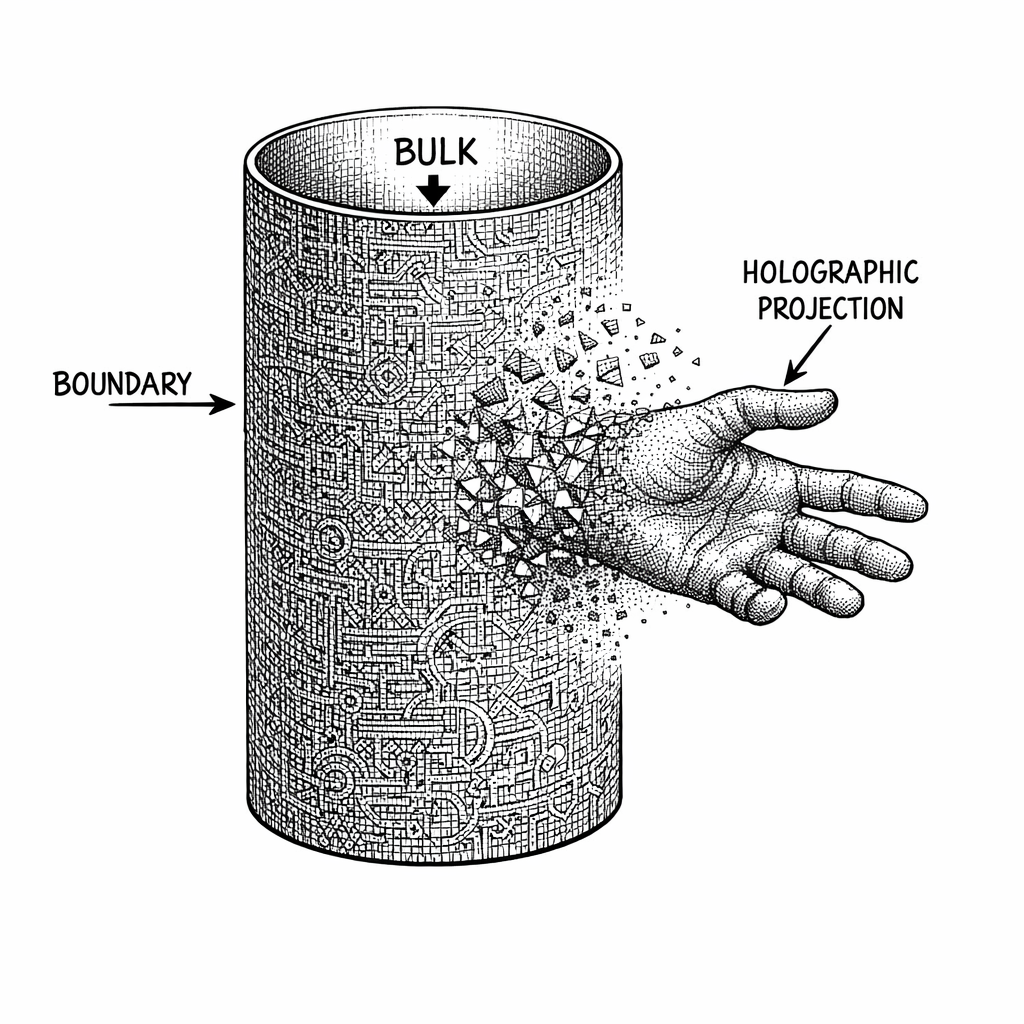
Verlinde applied this concept to the Holographic Principle (AdS/CFT) discussed in Chapter 3. He analyzed the 2D Boundary of the universe, where quantum information is encoded.
Verlinde proved mathematically that when a massive physical object sits in the vacuum of space, it creates an uneven distribution of quantum information on the Holographic Boundary. It creates a massive Information Gradient.
The universe moves to smooth out this uneven, low-entropy state.
When an apple falls from a tree, it is not being pulled by an invisible tether of fundamental gravity. It is being pushed by the thermodynamic force of information entropy.
To smooth out the distribution of information on the Boundary, the universe must physically move the apple toward the Earth. The physical movement of the apple is the thermodynamic byproduct of the universe rearranging its information ledger. Mass moves to balance a mathematical equation in the Holographic Bulk.
Gravity is the universe's thermodynamic reaction to an Information Gradient.
This provides a key insight for Dimensional Field Theory. Verlinde demonstrated that the distribution of information generates a quantifiable, physical force. If you create an uneven distribution of information, the universe will move mass to balance the thermodynamic ledger.
We finally have the missing mechanism. We know how the mind generates force.
4.4 The Thermodynamics of Attention (The Fisher Gradient)
To bridge the final gap in Dimensional Field Theory, we must translate the psychological experience of human consciousness into the mathematical language of information thermodynamics.
We must define Attention.
Throughout your day, your brain processes a constant stream of sensory data. At any given moment, your optic nerve transmits visual information, your auditory cortex processes ambient sound, your somatosensory cortex registers physical pressure, and your default mode network generates a stream of memories and thoughts.
This baseline, unfocused state of the mind is one of high uncertainty. In the language of Claude Shannon, the wandering mind is a state of high Information Entropy. It is a disorganized distribution of probabilities. Your observer wave function, , is smeared widely across the Semantic Dimension.
But when you choose to focus, this state changes.
You direct your conscious attention to the words on this page. You tune out the ambient sound. You ignore the feeling of the chair. You take the high-entropy state of your mind and compress it into a highly ordered point of focus.
In the language of physics, the psychological act of Attention is a deliberate decrease in Informational Entropy.
When you focus your mind, you are actively organizing information. You are taking a system with millions of possible states and forcing it into a highly defined state. By excluding other sensory inputs and locking onto a single target, you reduce your internal uncertainty.
But recall Landauer's Principle: Information is Physical. The universe keeps a strict thermodynamic ledger. You cannot decrease the entropy of a system without paying a physical cost.
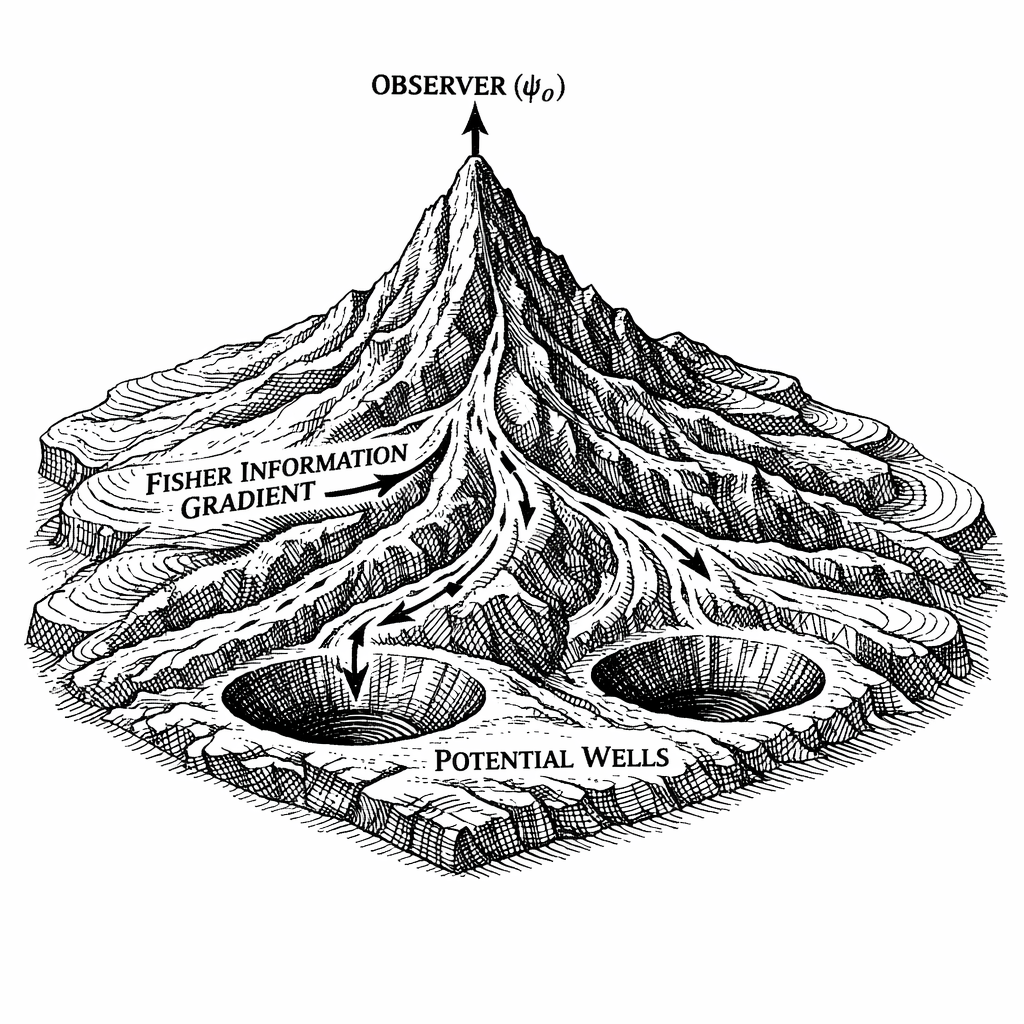
When your observer wave function (operating in the Semantic Bulk) focuses its attention, it drastically reduces its informational entropy. In the mathematics of Dimensional Field Theory, this generates a massive Fisher Information Gradient.
Fisher Information is a mathematical metric used in statistics and quantum metrology. It measures the "sharpness" or the gradient of a probability curve. A flat, uncertain curve has near-zero Fisher Information. A sharp, highly focused curve has high Fisher Information.
Imagine a flat, stretched rubber sheet representing the baseline entropy of the universe. When you focus your attention, you are decreasing the entropy of your local semantic coordinate. You are pulling a point on that sheet downward, creating a steep geometric well.
You have created a thermodynamic gradient in the geometry of the Semantic Bulk.
And physics provides a clear model for how the universe reacts to thermodynamic gradients.
4.5 The Cosmic Ledger: Wave Function Collapse as Phase Transition
We now arrive at a proposed resolution to the quantum measurement problem. We can address Stephen Hawking's question of what breathes fire into the equations, and Eugene Wigner's question of how the observer forces the universe to choose a reality.
Picture the physical universe as an ocean of quantum probabilities. Before observation, an electron exists in a state of Unitary evolution. It is in a superposition, mathematically representing a state of high quantum uncertainty and informational entropy. It is a cloud of "maybe."
Now, the human observer---coupled to the universe via the Decoherence-Free Subspace of the Posner molecules in their brain---focuses their attention to see where the electron is.
The Semantic Drop: The psychological act of focusing attention narrows the observer's wave function (). This decreases the entropy of their mind, generating a massive Fisher Information gradient (a topological cliff) in the Semantic Bulk.
The Entropic Debt: The First and Second Laws of Thermodynamics demand equilibrium. The universe seeks to balance this sudden information gradient in the Bulk. It creates a thermodynamic debt that must be resolved.
The Holographic Bridge: Because the observer's brain is physically coupled to the Bulk via the entangled nuclear spins (the ER=EPR wormholes inside the Posner molecules), this thermodynamic tension is transmitted from the Semantic Dimension to the 3D physical Boundary.
The Thermodynamic Collapse: To neutralize the information gradient generated by the observer's attention, the universe extracts order from the physical world. Applying the mechanism of Verlinde's Entropic Gravity, the universe strips the entropy out of the electron. It collapses the probability wave into a definite physical state.
The electron is found at one exact location on the detector screen. The wave function has collapsed.
The collapse of the wave function is not magical observer interference. It is not a mystical phenomenon where the mind pushes atoms.
The collapse of the quantum wave function is a rapid, inevitable information-thermodynamic phase transition.
Just as water freezes into solid ice when the thermal temperature drops, the quantum probabilities of the universe crystallize into physical reality when the ambient informational entropy of the observer drops.
Mind moves matter to balance the universe's checkbook.
When the nuclear spins in your brain collapse into a definite state, the symmetry of the Posner molecules is broken. The molecules break apart, releasing calcium ions. These ions force classical neurons to fire. The electrical grid of the brain illuminates. Your physical arm moves.
If this model is correct, Descartes' dualism is resolved. The mind and the body are not incompatible substances. They are two accounts on the same cosmic balance sheet, trading in the currency of information. The mind alters the mathematical ledger of the cosmos, and the universe moves the physical machine to compensate.
The framework proposes a bridge uniting biology, information theory, quantum mechanics, and string theory. It offers a mechanism where human consciousness can interact with physical reality without violating the laws of thermodynamics.
But this mathematical architecture faces a profound challenge. Looking closely at the equations of the Fisher Information gradient reveals a potential flaw. The mathematical formula requires dividing by the probability amplitude of the quantum field ().
In quantum mechanics, probability fields constantly fluctuate. If the probability of the wave function ever drops to exactly zero, the equation forces division by zero. In physics, dividing by zero generates infinities. The energy levels become infinite, and the theory becomes "non-renormalizable"---which is a physicist's polite way of saying the theory is mathematical garbage.
If Dimensional Field Theory is to hold, we must address these infinities. We must examine the fabric of space and time at the absolute microscopic limit of existence. We must descend to the Planck scale, and we must pixelate the universe.
References --- Chapter 4
[1] Shannon, C. E. (1948). A Mathematical Theory of Communication. Bell System Technical Journal, 27(3), 379-423.
[2] Landauer, R. (1961). Irreversibility and heat generation in the computing process. IBM Journal of Research and Development, 5(3), 183-191.
[3] Verlinde, E. (2010). On the Origin of Gravity and the Laws of Newton. Journal of High Energy Physics, 2011(4), 29.
Discussion (0)
No comments yet. Start the conversation!