Part III: The Mathematics of Meaning
Chapter 5: Pixelated Spacetime and the Death of Infinities
5.1 The Gorgon of Infinity
In theoretical physics, an equation is not judged merely by its elegance. It is evaluated on its ability to produce a finite, measurable number that can be tested in a laboratory. If an equation describing the physical universe yields the answer "infinity," the physicist has not discovered a boundless cosmic truth. The theory is broken.
In mathematics, infinity () is a fascinating concept explored in topology and set theory. Georg Cantor built a paradise of transfinite numbers that permanently expanded the human imagination. But to a physicist, infinity is an alarm bell. It is nature's way of rejecting a hypothesis.
An infinite amount of energy cannot be measured in a calorimeter. No particle with infinite mass has ever been observed, and infinite forces do not exist in nature. When a physical equation yields infinity, the mathematics is declaring that the limits of the model have been exceeded. The map has run off the edge of the known territory.
This problem of infinities challenged the architects of 20th-century physics. As physicists in the 1930s and 1940s tried to merge quantum mechanics with electromagnetism to create Quantum Electrodynamics (QED), their equations diverged. Calculating the mass of an electron or the strength of its electric charge required them to integrate over infinitesimally small distances. As the distance approached zero, the calculated electromagnetic force approached infinity. The theory became what physicists term "non-renormalizable."
Richard Feynman, Julian Schwinger, and Sin-Itiro Tomonaga developed a mathematical method called renormalization to cancel out these infinities, a feat that earned them the Nobel Prize. Yet even Feynman later confessed that renormalization felt like a mathematical sleight-of-hand---"sweeping the infinities under the rug" rather than fundamentally explaining the structure of reality.
Today, this mathematical hurdle is the primary reason we lack a working theory of quantum gravity. When physicists apply the continuous mathematics of Einstein's General Relativity to the microscopic scales of quantum mechanics, the equations frequently demand division by zero. The calculated curvature of spacetime becomes infinite. The theory collapses.
This brings us to a crisis hidden within the architecture of Dimensional Field Theory (DFT).
5.2 The Node of Destruction
In Chapter 4, the framework proposed a bridge between physics and consciousness. The psychological act of attention was modeled as a thermodynamic event. By focusing, an observer decreases their internal informational entropy. This creates a thermodynamic cliff in the Semantic Bulk---a Fisher Information Gradient. The universe, seeking equilibrium, balances the ledger by physically collapsing the quantum probability wave into a definite 3D reality.
The framework provides the mind with a physical engine. But looking closely at the formalized equation for Fisher Information reveals a mathematical paradox.
The mathematical formulation for the Fisher Information density of a quantum field () along the semantic coordinate () is expressed as the square of the gradient of the probability field, divided by the probability itself:
Notice the denominator of the fraction: .
This term represents the probability amplitude of the physical quantum field. In standard, continuous quantum mechanics, wave functions are smooth mathematical curves. Like waves on an ocean, they have peaks and troughs. Crucially, waves also have nodes---geometric points where the wave crosses the baseline. At a node, the probability amplitude () is exactly zero.
If the quantum probability field hits a node---if equals 0---the denominator of the Fisher Information equation becomes zero.
Dividing a number by zero causes the result to approach infinity.
If this happens, the Fisher Information gradient becomes infinitely steep. The thermodynamic force of attention becomes unbounded. The mathematical framework of Dimensional Field Theory breaks down.
A theory predicting that human thought generates infinite energy is not merely wrong; it is absurd. The simple act of observing an empty point in space would require infinite energy, collapsing the entire universe into a black hole.
If we cannot cure the infinities, DFT is dead.
To save the theory, we cannot simply sweep the zero under the rug. We must alter our understanding of the fabric of space and time, demonstrating that a true mathematical void is physically impossible to achieve.
To do this, we leave the realm of the atom and explore the thermodynamics of black holes.
5.3 The Black Hole's Secret (The Bekenstein Bound)
In the early 1970s, astrophysicists were engaged in an intense debate over the nature of black holes.
According to Albert Einstein's General Relativity, a black hole is a region of spacetime where gravity is so intense that nothing, not even light, can escape. Its boundary is called the Event Horizon. Once an object crosses the event horizon, it falls inevitably toward the center, crushed into an infinitely dense point called a singularity.
But a graduate student at Princeton named Jacob Bekenstein realized that this classical description contained a severe violation of the laws of physics.
Bekenstein looked at the Second Law of Thermodynamics, which dictates that the total entropy in the universe must always increase. If you take a hot cup of coffee and throw it into a black hole, the coffee disappears behind the event horizon. To an outside observer, it looks as though the entropy of the universe just decreased. The black hole seemed to be destroying information, acting as a cosmic disposal that erased entropy from existence.
If black holes destroy entropy, the Second Law of Thermodynamics is broken. If the Second Law is broken, the arrow of time ceases to exist.
Bekenstein's mentor, John Archibald Wheeler, pushed him to solve the paradox. In 1973, Bekenstein published a paper that altered the trajectory of modern physics [1].
Bekenstein proposed that black holes do possess entropy and do not destroy information. Instead, when you throw a cup of coffee into a black hole, the information contained in that coffee---the quantum state of every atom---is encoded onto the 2-dimensional surface of the Event Horizon.
The black hole stores information. But Bekenstein's greatest discovery was the strict mathematical limit on its capacity.
He proved that the maximum entropy contained in any given region of space is proportional to the surface area of that region, not its volume. There is an absolute physical limit to this storage capacity.
This became known as the Bekenstein Bound.
To understand this discovery, consider its geometric implications. In classical physics, space is viewed as a continuous grid. A line can be divided forever. Between the numbers 1 and 2, there is an infinity of fractions.
If space is continuous, a single cubic centimeter should be able to hold an infinite amount of information. One could simply keep zooming in, encoding data into ever-smaller coordinates.
But the Bekenstein Bound mathematically forbids this. It proves there is a finite, calculable maximum limit to how much information can exist in a given volume.
If there is a finite limit to information, space cannot be continuous.
Zoom in far enough, and you reach a limit. This is the lowest possible resolution of reality. The Bekenstein Bound demonstrated that the fabric of the universe is not infinitely divisible.
The universe is a digital photograph. Spacetime is pixelated.
5.4 From "It from Bit" to "It from Qubit"
John Archibald Wheeler---who had mentored Bekenstein, Richard Feynman, and Hugh Everett---spent his late career analyzing the implications of the Bekenstein Bound. He urged physicists to look beyond the mechanical interactions of particles and forces to the underlying architecture of reality.
In 1989, Wheeler published an essay synthesizing his work. He proposed a philosophical paradigm for the cosmos, summarized in a three-word phrase: "It from Bit" [2].
Wheeler argued that the universe is not fundamentally made of matter, energy, or even spacetime. The universe is an information processing system. Every particle, every force field, and every geometric curvature of spacetime is ultimately built out of binary yes-or-no questions---bits of information.
"Every it---every particle, every field of force, even the spacetime continuum itself---derives its function, its meaning, its very existence entirely from binary choices, bits. What we call reality arises in the last analysis from the posing of yes-no questions."
Wheeler's "It from Bit" was a brilliant intuition, but it was constrained by the technology and mathematics of the 1980s, which were based on classical computers. Classical bits are rigid: either a 1 or a 0.
The universe, however, runs on quantum mechanics.
In the 21st century, theoretical physicists---working in string theory, loop quantum gravity, and holographic physics---have taken Wheeler's intuition and upgraded it to match the mathematics of quantum entanglement.
The new paradigm of modern physics is "It from Qubit" [3].
A qubit can exist in a superposition of both 1 and 0 simultaneously, and it can become entangled with other qubits across vast distances.
Today, using the Holographic Principle explored in Chapter 3, physicists mathematically model the universe not as a void filled with particles, but as a network of entangled quantum information. Space and time do not exist independently; they literally emerge from this microscopic web of quantum entanglement. Remove the entanglement, and the fabric of space itself tears apart.
This brings us to the bedrock pixel of reality.
If the universe is built out of discrete qubits of information, what is the physical size of one pixel of spacetime? Theoretical physics provides an exact answer: the Planck Length, calculated by combining the speed of light, the gravitational constant, and Planck's constant.
The Planck Length is meters.
It is a length so microscopic that if a single atom were scaled up to the size of the entire visible universe, the Planck length would be the size of a tree.
Below the Planck scale, the concepts of "space" and "distance" mathematically cease to exist. There is no half a Planck length, just as there is no half a pixel on a monitor. It is the baseline resolution of the holographic boundary. At this scale, the continuous curves of the quantum wave function break down into a discrete matrix of individual quantum bits.
With the universe pixelated at the Planck scale, we possess the mathematical framework required to resolve the infinities in Dimensional Field Theory.
5.5 The Pixelation of Probability and the Planck Minimum
Let us return to the equation that threatened the framework:
The concern was that the probability amplitude of the physical field () could reach exactly zero at a wave node. If the denominator is zero, the Fisher Information gradient explodes to infinity, the thermodynamic force of attention becomes unbounded, and the theory fails.
But what does it actually mean for a probability to be exactly zero?
In a smooth, continuous mathematical universe, it is easy to write down the number 0. But recall Landauer's Principle from Chapter 4: Information is Physical.
To define a physical state with infinite precision---to say that a wave function has a probability of exactly 0.000000... stretching out to infinite decimal places---requires an infinite amount of information.
The Bekenstein Bound forbids this. Any finite region of space can only hold a finite amount of information. Because the universe is pixelated into discrete qubits at the Planck scale, infinite precision is physically impossible.
Because the fabric of reality is quantized, the quantum probability field is not a perfectly smooth curve that crosses the baseline at an infinitely precise zero. The field is composed of discrete packets of information.
Therefore, the probability amplitude can never reach absolute zero.
Even in the emptiest vacuum of space, at the lowest possible energy state, the field does not drop to zero. In quantum field theory, this is known as the vacuum state or zero-point energy, a consequence of Heisenberg's Uncertainty Principle. A true void is physically impossible. The vacuum is always seething with quantum fluctuations.
What is the lowest state the field can reach?
Because the universe is built out of discrete qubits, the minimum value of the probability field is exactly one quantum bit of information existing at the scale of the Planck length.
We mathematically define this lower limit as the Planck Minimum ().
The field is mathematically forbidden from dropping below . The universe bottoms out at the Planck scale. The pixel cannot be divided.
5.6 The Renormalizable Mind: The Salvation of DFT
By applying the physics of the Bekenstein Bound, Holographic Information Theory, and Planck-scale quantization, we rewrite the Fisher Information interaction of Dimensional Field Theory.
To account for the pixelated, discrete nature of spacetime, we regularize the denominator. The equation must reflect the physical reality that the field cannot drop below the fundamental informational resolution of the universe.
The regularized equation for the thermodynamic gravity of attention is:
Because of the term (the Planck Minimum), the denominator can never equal zero. Even if the macroscopic wave function drops to its lowest possible state, the denominator hits the hard floor of .
Because the denominator is strictly positive, division by zero is impossible.
The infinities vanish.
When your observer wave function () sharply focuses in the Semantic Bulk, it creates a massive Fisher Information gradient. The thermodynamic entropic force generated by your mind is immense. It is fully capable of overcoming the thermal noise of the Posner molecules in the brain, collapsing the quantum wave function, and actualizing a definite 3D reality.
But crucially, because of the pixelation of spacetime, this semantic force has a strict mathematical limit.
The force of attention is powerful, but it is ultimately finite.
The mathematics of Dimensional Field Theory are now bounded and renormalizable. The framework proposes a bridge between the Hard Problem of Consciousness and the Quantum Measurement problem: a biological antenna (nuclear spin), a causal geometry (the Holographic Bulk), an energetic engine (Information Thermodynamics), and mathematics free of divergences.
The architecture holds. Whether it holds under experimental scrutiny remains to be seen.
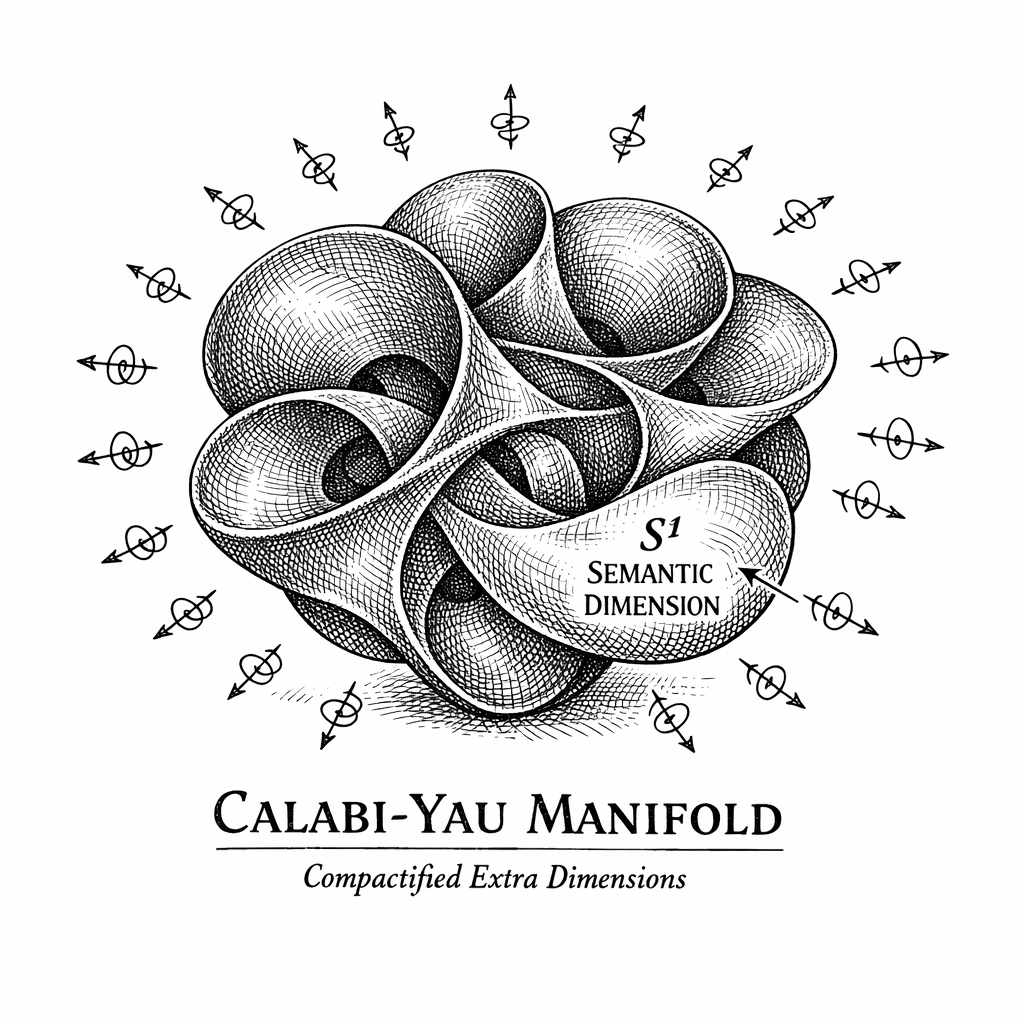
If Dimensional Field Theory is a true physical description of the cosmos, the Semantic Dimension must obey the laws of particle physics. If there is a hidden dimension of consciousness, why have we never seen it? Why hasn't it shown up in the particle collisions at the Large Hadron Collider in Geneva? If the mind exerts thermodynamic gravity, what is the physical mass of that interaction?
To move DFT from a philosophical framework to a falsifiable physical theory, we must now calculate the exact dimensions of the soul. We must weigh the Semantic Dimension, and discover where it is hiding in the blind spot of modern experimental physics.
References - Chapter 5:
[1] Bekenstein, J. D. (1973). Black holes and entropy. Physical Review D, 7(8), 2333-2346.
[2] Wheeler, J. A. (1990). Information, physics, quantum: The search for links. Complexity, entropy, and the physics of information, 8, 3-28.
[3] Susskind, L. (1995). The World as a Hologram. Journal of Mathematical Physics, 36(11), 6377-6396.
Discussion (0)
No comments yet. Start the conversation!