Part II: The Architecture of the Bulk
Chapter 3: The Holographic Mind and ER=EPR
3.1 The Absolute Sanctity of Causality
Proposing a new theory of reality---especially one that grants the human mind causal power over the physical universe---eventually requires facing the boundaries established by Albert Einstein.
Einstein's Theory of Special Relativity is often summarized by a single axiom: Nothing can travel faster than the speed of light in a vacuum (). We are taught to imagine this as a cosmic speed limit imposed on spaceships and photons, an intergalactic traffic law preventing easy travel between star systems.
To a theoretical physicist, however, the speed of light is not solely about light. Light happens to be one of the phenomena that travel at this maximum velocity because photons are massless. The constant (299,792,458 meters per second) represents something more profound.
It is the speed limit of Causality.
Causality is the foundational bedrock upon which logic is built. It is the simple rule that a cause must precede an effect. If you drop a glass on a tile floor, the dropping must happen before the shattering. You must be born before you die.
In the 4-dimensional fabric of spacetime that Einstein mapped, time and space are woven together into a single continuum. How you experience time and distance depends on your relative velocity. Because of the Lorentz transformations governing this fabric, transmitting a signal faster than the speed of light does not just mean traveling fast. It means transmitting information backward in time relative to certain observers.
Sending a message backward in time breaks causality. It creates the Grandfather Paradox: you could send a faster-than-light signal to a detonator that destroys your transmission machine before you ever send the signal.
If causality breaks, the mathematical framework of reality dissolves into paradox. The glass shatters before it is dropped. Stars explode before they run out of fuel. Effect precedes cause.
For this reason, physicists closely guard the speed of light limit. Any physical theory that allows for "superluminal" (faster-than-light) communication is generally considered inviable, regardless of its mathematical elegance or biological plausibility.
This brings us to a significant problem with Dimensional Field Theory (DFT), and the paradox of the quantum mind.
3.2 The Polchinski Paradox and the Nonlinear Nightmare
In the standard textbook interpretation of quantum mechanics, a wave function is a mathematical distribution of probabilities that evolves smoothly over time, governed by the Schrodinger equation.
Crucially, standard quantum mechanics is linear. In mathematics, linearity means that adding two valid solutions to an equation yields a third valid solution. The output is proportional to the input. In physics, the linearity of the Schrodinger equation is the safeguard that protects Einstein's causality.
Because quantum mechanics is linear, it enforces what physicists call the No-Signaling Theorem.
To understand this, we must look at quantum entanglement---what Einstein called "spooky action at a distance." If you take two entangled electrons and separate them by a million light-years, measuring the spin of the first electron will instantly dictate the spin of the second electron. It appears as though a signal has traveled between them faster than the speed of light.
But because of the linear math, the outcome of your measurement is always random. You cannot force your electron to be "Spin Up" to send a Morse code message to a friend a million light-years away. You will get a random result, and your friend will get the opposite random result. You share correlated information, but you cannot use entanglement to send a controlled message. You cannot build a faster-than-light telephone. The No-Signaling Theorem holds, and Einstein's causality survives.
Dimensional Field Theory, however, requires a departure from standard quantum mechanics.
As we explored in Chapter 1, consciousness must have causal power to survive evolutionary natural selection. In Chapter 2, we mapped the biological Topological Antenna (the Posner molecule network) that allows the brain to couple with the Semantic Dimension.
In DFT, the observer is not passive. When your mind focuses its attention, it generates a quantifiable thermodynamic force (the Fisher Information gradient) that actively alters the probability weights of the physical wave function. Your mind prompts the universe to choose a specific reality.
Mathematically, any process where the state of the observer actively changes the evolutionary dynamics of the wave function is nonlinear.
In 1989, Nobel laureate Steven Weinberg published a paper exploring a hypothetical version of quantum mechanics that included slight non-linear tweaks [1]. Two years later, theoretical physicist Joseph Polchinski investigated Weinberg's framework to see what happens if nonlinearity is introduced into the quantum realm.
Polchinski published his findings in a paper titled Weinberg's nonlinear quantum mechanics and the Einstein-Podolsky-Rosen paradox [2].
He demonstrated mathematically that if quantum mechanics is even slightly nonlinear, the No-Signaling Theorem collapses.
In a nonlinear quantum universe, the probabilities are no longer strictly random. You could manipulate your local entangled electron in a way that biases the probabilities of a distant electron. Because the observer's state actively influences the collapse, you could use the entanglement to send a controlled signal. You would have built a faster-than-light telephone.
This is the Polchinski Paradox. It presents a major theoretical hurdle for models of quantum consciousness.
If Dimensional Field Theory is correct---if the human mind exerts a nonlinear, state-dependent force on the quantum probability field---then according to Polchinski's math, a focused meditator on Earth could manipulate an entangled nuclear spin in their brain, which would instantly alter the state of an entangled particle on Mars. This would transmit information faster than the speed of light.
If DFT breaks causality, the timeline unravels.
For a classical physicist, this paradox demands the theory be abandoned to preserve causality. But we are searching for a deeper geometry.
When a theory hits a paradox in three dimensions, one potential solution is to add a dimension.
3.3 The Holographic Lifeline (AdS/CFT)
In 1997, theoretical physicist Juan Maldacena published a paper that reshaped the field. Today, it remains one of the most cited papers in high-energy physics [3].
Maldacena was attempting to unify Quantum Mechanics and General Relativity. Historically, attempting to combine the equations of these two frameworks produced mathematical infinities.
Maldacena discovered a mathematical translation between the two, formally known as the AdS/CFT Correspondence or the Holographic Principle.
To understand this, consider the concept of a hologram. If you look at a holographic security image on a credit card, you are looking at a flat, 2-dimensional surface. But as you tilt the card, the image appears to have 3-dimensional depth. The information required to construct a 3-dimensional reality is mathematically encoded on a 2-dimensional boundary. The 3D world is a projection of the 2D surface.
Maldacena proved mathematically that the universe operates on this principle, scaled up by one dimension.
Maldacena built a model universe. The interior of this universe---the 3D space where gravity exists---is called the Bulk. In his original 1997 mathematics, he utilized a negatively curved, hyperbolic geometry known as Anti-de Sitter (AdS) space.
While AdS/CFT provided a mathematical translation, our actual universe is asymptotically flat (Minkowski space). To apply this to reality, physicists utilize Celestial Holography (or Flat-Space Holography). Utilizing Bondi-Metzner-Sachs (BMS) asymptotic symmetries at null infinity, this framework shows that the complex, 4D gravitational scattering of particles in our flat universe is encoded on a lower-dimensional 'Celestial Sphere.'
Wrapping around this Bulk, like the skin of a balloon enclosing the air inside, is the Boundary. The Boundary has one less spatial dimension than the Bulk. It is flat, and crucially, there is no gravity on the Boundary. The Boundary is governed by the linear laws of standard quantum mechanics (a Conformal Field Theory, or CFT).
Maldacena demonstrated a mathematical equivalence between the two. He showed that every complex, nonlinear, gravitational event happening inside the 3D Bulk is equivalent to a linear quantum event happening on the 2D Boundary.
They are two mathematical languages describing the same physical reality.
If two black holes collide in the Bulk, you can look at the Boundary and see an equivalent, linear ripple of quantum particles. The Bulk is the 3D hologram; the Boundary is the 2D film projecting it.
The Holographic Principle gives physicists a valuable tool. When the math of gravity in the Bulk becomes too complex to solve, physicists can translate the problem to the Boundary, solve it using linear quantum mechanics, and translate the answer back.
For our framework, the Holographic Principle offers a way to navigate the constraints of causality.
It mathematically proves that a physical system can be nonlinear in higher dimensions, while its holographic projection remains linear in the lower dimensions.
To apply this to the mind, we must understand how the Holographic Principle treats quantum entanglement. We need to know what entanglement looks like when viewed from within the Bulk.
3.4 ER = EPR: Wormholes and Ghosts
In 1935, Albert Einstein co-authored two distinct papers with his colleagues at the Institute for Advanced Study in Princeton.
In the first paper, written with Nathan Rosen, Einstein used his equations of General Relativity to propose the theoretical existence of macroscopic bridges through spacetime. If you warp the fabric of spacetime with intense gravity, you can connect two distant points. They called these "Einstein-Rosen bridges," commonly known as wormholes. They are denoted in physics shorthand as ER.
A few months later, in a second paper written with Boris Podolsky and Nathan Rosen, Einstein formulated the paradox of quantum entanglement. He highlighted the mathematics showing that two particles could be linked across vast distances, reacting to one another's measurements. He considered this action at a distance to be evidence that quantum mechanics was incomplete. This paradox became known as the Einstein-Podolsky-Rosen paradox, denoted as EPR.
For decades, the physics community treated ER and EPR as unrelated phenomena. ER was a macroscopic, gravitational anomaly involving spacetime curvature. EPR was a microscopic, quantum anomaly involving the statistical probabilities of subatomic particles.
In 2013, Juan Maldacena and Leonard Susskind---one of the founding architects of String Theory---published a paper bridging the microscopic and macroscopic worlds.
The paper was titled Cool horizons for entangled black holes [4]. Their thesis became known by the equation: ER = EPR.
Susskind and Maldacena used the Holographic Principle to look at quantum entanglement from the perspective of the higher-dimensional Bulk. They proposed that Einstein's two paradoxes of 1935 were the exact same phenomenon.
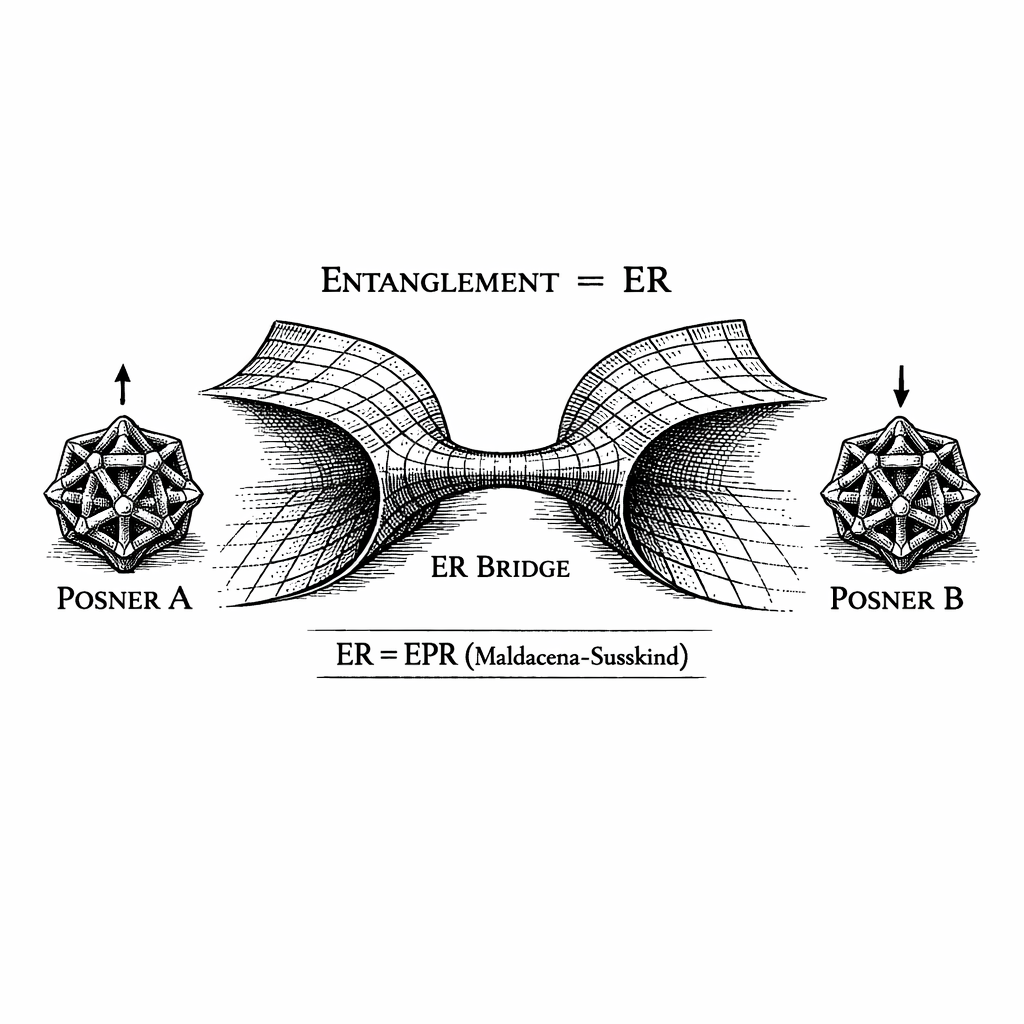
They demonstrated mathematically that quantum entanglement is not merely an invisible statistical correlation across flat space. Entanglement is a literal, physical, geometric wormhole.
When two entangled electrons are separated by interplanetary distances, they do not communicate across the 3D vacuum. Instead, a microscopic Einstein-Rosen bridge---a tunnel through the fabric of the higher-dimensional Bulk---forms between them.
Through the geometry of the wormhole, the two electrons are touching. They occupy the same geometric point in the Bulk.
An Einstein-Rosen bridge (a macroscopic wormhole) is a massive entangled state. An entangled pair of quantum particles (EPR) is a microscopic wormhole. ER = EPR.
The universe is not a collection of isolated particles in an empty void. It is a connected network of geometric wormholes stretching through higher dimensional space. The 3D world we observe is the flat Boundary. The Bulk is a labyrinth of quantum tunnels.
With ER=EPR established, the framework has the pieces required to address the Polchinski Paradox.
3.5 The Architecture of the Semantic Bulk
As we established in Chapter 1, consciousness is modeled not as an emergent property, but as a compactified dimension of reality---the Semantic Dimension.
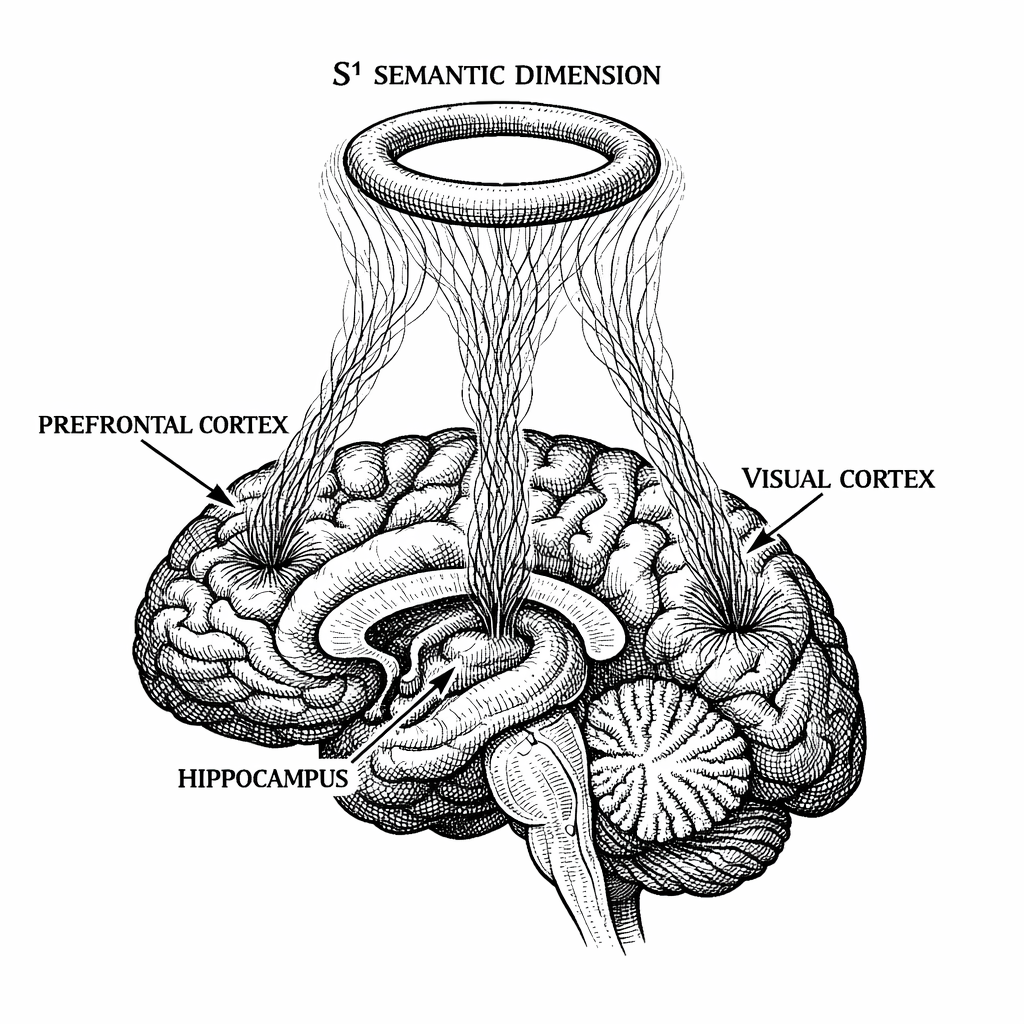
In Chapter 2, we proposed that the brain acts as a Topological Antenna. Through the Decoherence-Free Subspace of the Posner molecule network, the brain creates a web of quantum entanglement, shielding it from thermal noise and interfacing with the dimension.
We can now map this biology onto Maldacena's holographic framework.
In this framework, the 3D physical world we measure with telescopes and microscopes---the world of linear quantum mechanics and the speed of light---is the Boundary.
The Semantic Dimension---the dimension of subjective experience---is the Bulk.
When your brain generates entangled pairs of phosphorus nuclear spins inside its Posner molecules, it is not just creating a statistical correlation in 3D space. According to ER=EPR, the brain is weaving billions of microscopic geometric wormholes through the Semantic Bulk.
Your physical skull exists on the Boundary. But the quantum entanglement web inside your skull is a bridge extending into higher dimensions. You are a multi-dimensional geometric structure.
This brings us to the resolution of the paradox. How does the mind actively collapse the wave function without breaking causality and allowing faster-than-light signaling?
3.6 Resolving the Paradox: The Holographic Mind
Imagine you are sitting in a quiet room, and you consciously decide to shift your attention to the sound of a ticking clock.
According to Dimensional Field Theory, this psychological act of attention generates a quantifiable thermodynamic force---a Fisher Information gradient. Crucially, this force does not act on the 3D Boundary.
The force of conscious attention acts on the geometry of the ER wormholes inside the Semantic Bulk.
When you focus your mind, your observer wave function operates dynamically in the higher dimension. You are reaching into the Bulk, interacting with the Einstein-Rosen bridges that connect the entangled particles in your brain, altering the geometry of the Bulk.
Is this process nonlinear? Yes. The geometry of the Bulk is governed by gravity (in this case, the 'gravity' of attention), and gravity is inherently nonlinear. Your mind exerts a nonlinear, causal force on the fabric of reality. You are actively choosing a physical outcome rather than acting as a passive observer.
What happens when this nonlinear collapse in the Bulk projects its "shadow" onto the 3D Boundary---the physical reality we observe?
The AdS/CFT Correspondence proves that no matter how nonlinear the events in the higher-dimensional Bulk become, their holographic projection onto the lower-dimensional Boundary will always obey the linear laws of quantum mechanics.
The mind executes a nonlinear choice in the Semantic Dimension.
The universe translates that choice into a linear wave-function collapse in the 3D physical dimension.
Because the projection on the Boundary remains linear, the No-Signaling Theorem holds. You cannot use this mental force to build a faster-than-light telephone to Mars. You cannot use it to send a message backward in time or trigger the Grandfather Paradox.
If Alice focuses her mind, she uses the non-linear dynamics of the Bulk to collapse the wormholes in her brain, causing her neurons to fire. She possesses causal free will over her biological machinery. But if she tries to use that same mental force to collapse an entangled particle held by Bob on Mars, the Holographic Principle enforces the speed of light. The "shadow" cast onto 3D reality remains linear. Bob measures a random outcome and receives no message. Causality is preserved.
Einstein's speed of light remains the limit of causality in the 3D physical world.
The Polchinski Paradox is disarmed. By elevating consciousness to the status of a higher-dimensional Bulk geometry, the framework grants the mind physical causal power while preserving the mathematics of relativity.
The result is a holographically secure, biologically viable cosmology.
The universe is not a syntactic stage; it is a holographic projection of semantic geometry. And the human brain is the evolutionary key capable of reaching into the Bulk.
To complete the physics of the mind, we must address one final question. We know where the mind operates (the Bulk), what it interfaces with (entangled nuclear spins), and why it doesn't break causality (holographic projection).
But how does a thought move a physical atom? Where does the energy required to collapse a quantum state originate? If the mind is distinct from 3D matter, how does it avoid violating the Conservation of Energy? To answer this, we must explore the Thermodynamics of Attention.
References --- Chapter 3
[1] Weinberg, S. (1989). Precision tests of quantum mechanics. Physical Review Letters, 62(5), 485-488.
[2] Polchinski, J. (1991). Weinberg's nonlinear quantum mechanics and the Einstein-Podolsky-Rosen paradox. Physical Review Letters, 66(4), 397-400.
[3] Maldacena, J. M. (1998). The large N limit of superconformal field theories and supergravity. Advances in Theoretical and Mathematical Physics, 2(2), 231-252.
[4] Maldacena, J., & Susskind, L. (2013). Cool horizons for entangled black holes. Fortschritte der Physik, 61(9), 781-811.
Discussion (0)
No comments yet. Start the conversation!