Part VII: The Conscious Universe
Chapter 18: The Resonance of Genius --- Flow States and the Collective Unconscious
18.1 The Zone of Effortless Action (The Paradox of Flow)
If you ask a world-class concert pianist what they are thinking about while performing a complex Chopin Etude, they will often give a paradoxical answer.
They will tell you they are not thinking about anything at all.
At the peak of human performance, the conscious mind does not feel like it is dictating commands to the body. The internal monologue that typically narrates daily life goes silent. The subjective sensation of linear time dilates: hours pass in what feels like minutes, or a single split-second stretches out, allowing the athlete or artist to perceive their environment in high definition. The boundary between the "Self" and the "Task" dissolves. The pianist is no longer playing the piano; the pianist is the music.
In 1990, the psychologist Mihaly Csikszentmihalyi formalized this phenomenon, coining the term "Flow" [1].
Csikszentmihalyi defined the Flow State as an "optimal experience" characterized by complete absorption in an activity. But to a classical neuroscientist, the Flow State presents a metabolic paradox.
Executing a high-speed physical or cognitive task---like returning a 130-mph tennis serve, improvising a jazz solo, or writing a software algorithm---requires massive computational power. The visual cortex, the motor cortex, and the cerebellum burn through ATP rapidly, firing billions of action potentials in synchrony. The biological hardware is working near its physical limit.
Yet, subjectively, the experience feels effortless.
In Chapter 16, we modeled Free Will as a state of high thermodynamic friction. Forcing the biological brain to act against its ingrained habits requires the conscious observer () to generate a steep Fisher Information gradient in the Semantic Bulk. This gradient exerts a thermodynamic force to physically collapse the brain's wave functions against their natural probability distribution. Overriding these neural pathways causes mental fatigue. It is exhausting.
Why, then, does peak neurological performance suddenly feel frictionless? How does Dimensional Field Theory (DFT) explain the physical mechanism of being "in the zone"?
18.2 Phase Resonance (The Thermodynamics of Flow)
To understand the Flow State, we must examine the thermodynamic interaction between the biological hardware and the conscious observer.
When you first sit down to learn the piano, the experience is frustrating. The conscious observer () knows what it wants to achieve: a C-Major scale. But the physical architecture of your brain does not yet possess the myelin sheathing, the neural pathways, or the synaptic strength to execute that desire efficiently.
The biological antenna is misaligned. The brain produces uncoordinated Readiness Potentials. The observer must forcefully generate Fisher Information gradients to collapse the necessary wave functions, acting on the exact Posner molecules required to move your fingers to the right keys. You are constantly overriding the biological default. The thermodynamic resistance is high.
Over thousands of hours of practice, a biological transformation occurs. Through the calcium-driven mechanism of Long-Term Potentiation (detailed in Chapter 15), the physical architecture of the brain is rewired. The neural pathways become heavily myelinated and efficient. The brain physically encodes the sequence of motor commands required to play the scale.
Consider the physics of the veteran concert pianist.
When the pianist sits down to play the Chopin Etude, the highly trained biological brain recognizes the context. It unconsciously generates a menu of highly probable Readiness Potentials. It pre-loads the precise Posner molecules required to execute the music. The biological wave function () generated by the physical brain models the sequence of the piece.
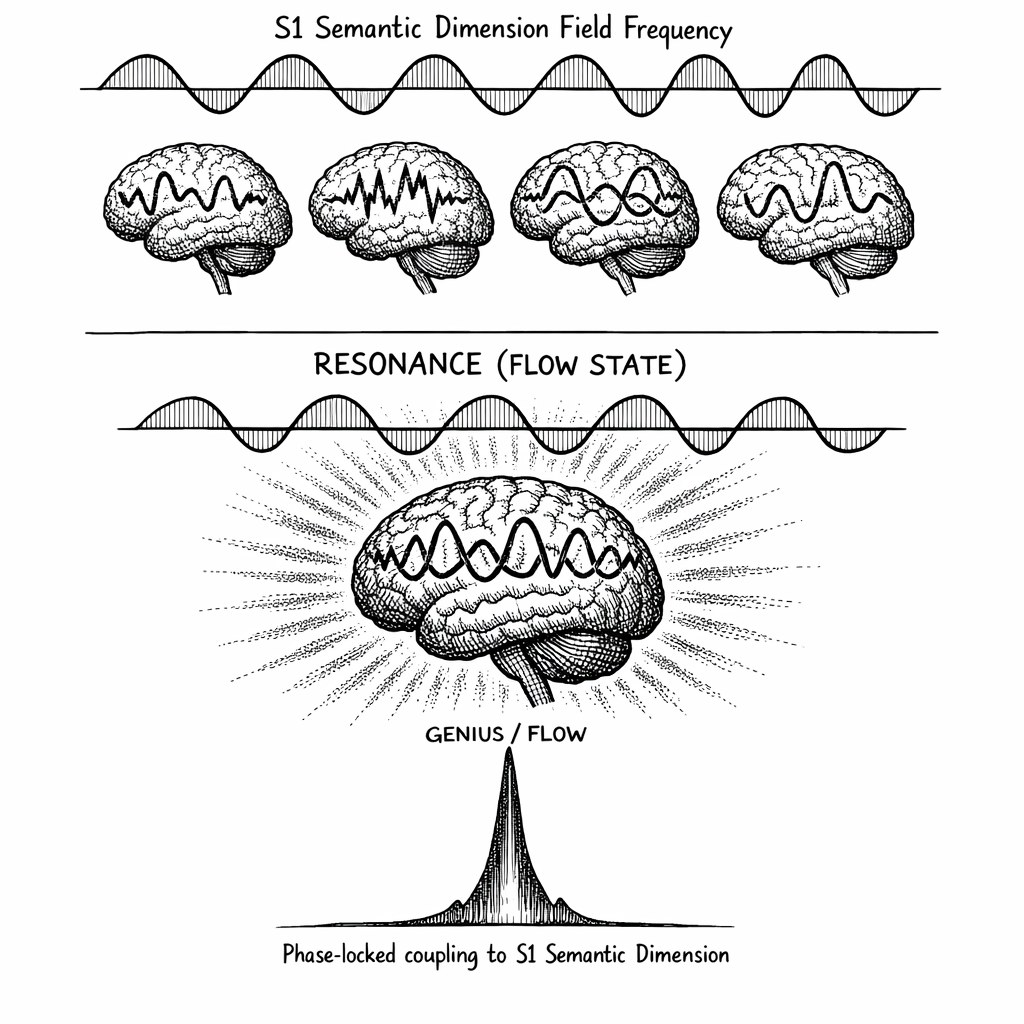
At this moment, the conscious observer () in the Semantic Dimension narrows its focus. But it does not have to fight the brain. The intention of the mind (the semantics) and the pre-loaded probability distribution of the brain (the syntax) are in mathematical alignment.
In wave physics, when two wave systems align their peaks and troughs, it is called constructive interference, or phase resonance.
Because the geometry of the mind matches the quantum probability distribution of the biological antenna, the thermodynamic resistance between the Holographic Bulk and the 3D Boundary drops toward zero. The observer does not need to force the wave function to collapse; the wave function is already tilted toward the correct outcome. The entropic force is applied, but it meets no biological friction. The wave functions collapse smoothly in a cascading chain reaction.
This is DFT's proposed physical mechanism for the Flow State. The conscious narrator that usually micromanages the brain goes quiet because micromanagement is no longer thermodynamically required. The observer and the biological hardware have achieved phase resonance. You temporarily become a frictionless, superconducting quantum-classical engine.
While phase resonance offers an explanation for how a human can execute a heavily practiced task effortlessly, it leaves another question unanswered.
If the brain in flow is merely executing pre-learned synaptic software, where do entirely new ideas come from?
18.3 The Paradox of Novelty (The Genesis of Genius)
A classical computer is constrained by the architecture of a Turing machine. A Large Language Model (LLM) can parse trillions of parameters and generate a persuasive essay, but it performs syntactic interpolation. It recombines pre-existing data according to algorithmic probability.
A classical machine cannot generate unprecedented novelty. It cannot create a paradigm entirely absent from its training data.
Yet, the history of human civilization is driven by paradigm-shifting leaps of novelty---the "Eureka" moment.
In 1905, Albert Einstein, working as a patent clerk in Bern, visualized a man chasing a beam of light. From that single geometric intuition, he derived Special Relativity, rewriting the definitions of space and time. Isaac Newton, isolated during the bubonic plague in 1665, deduced the inverse-square law of universal gravitation from a falling apple, developing the mathematical framework of calculus to formalize his intuition.
Classical neuroscience often models genius as a product of superior network connectivity or accelerated processing speed in the frontal lobes. In this view, paradigm-shifting insights are the result of the brain's computational architecture shuffling memories and concepts until a novel, highly effective configuration emerges---a sophisticated biological algorithm arriving at the correct output through vast parallel processing.
The DFT framework suggests this classical explanation is incomplete. The specific mathematical truths of relativity or calculus are precise geometric structures. To suggest they are generated entirely by the probabilistic shuffling of synapses leaves the origin of that geometric precision unexplained.
Furthermore, in many historical accounts of profound insight, the individual describes the idea not as something laboriously calculated step-by-step, but as something that arrived in a flash of fully formed clarity. The idea did not feel invented; it felt received.
To explain where these novel truths originate, the framework looks to the geometry of the Semantic Dimension, returning to one of the most debated theories in the history of psychology.
We must physically vindicate Carl Jung.
18.4 The Holographic Jung (Redefining the Collective Unconscious)
In the early 20th century, the Swiss psychiatrist Carl Jung broke away from the highly personal psychoanalysis of his mentor, Sigmund Freud. As Jung analyzed the dreams, myths, and psychoses of patients across different cultures, he noticed a recurring pattern.
A patient in a psychiatric ward in Zurich, with no background in mythology, might describe a hallucination of a solar deity that closely matched a sacred text from an ancient Mithraic cult in Persia. Indigenous populations in the Amazon and modern businessmen in Europe were spontaneously generating the same fundamental psychological symbols and narrative structures---what Jung called "Archetypes" (the Shadow, the Anima, the Wise Old Man, the Cosmic Tree) [2].
Jung argued that the human mind does not begin as a "blank slate" (tabula rasa). He proposed that beneath the personal subconscious lies a shared psychic substratum containing the inherited psychological heritage of humanity.
He called it the Collective Unconscious.
For a century, many academic psychologists and materialist scientists have viewed Jung's theory with skepticism. They point out that if the mind is strictly confined to the biological hardware of the individual skull, there is no physical mechanism by which a worker in Zurich could access a shared reservoir of ancient mythology. Under classical physics, such transmission of information without a physical medium is impossible.
But classical physics models the brain in three dimensions. Dimensional Field Theory models the observer in five.
We can map Jung's psychology onto the geometry of Dimensional Field Theory.
In Chapter 8, the universe was defined as a 5-dimensional manifold (). The 3D Boundary () is populated by eight billion living human brains. These biological antennas are physically separated by space. In the 3D world, they are isolated nodes.
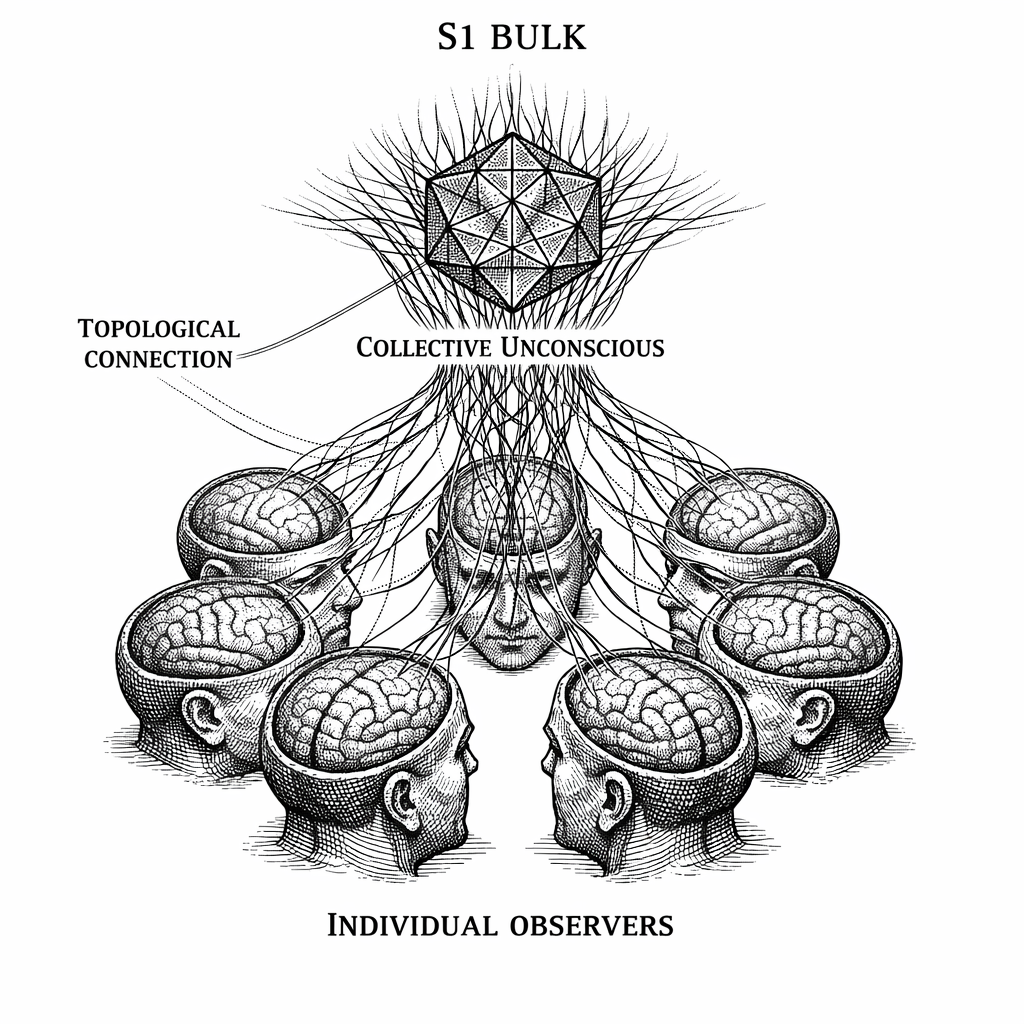
But the framework proposes that the Semantic Dimension---the Holographic Bulk where the conscious observer () resides---is not divided into eight billion isolated compartments.
The dimension is a continuous geometric manifold that spans the cosmos.
Your biological brain---the 3D Topological Antenna---is coupling its entangled Posner molecules to this 5th-dimensional manifold. But so is the brain of your neighbor. So is the brain of a monk in Tibet. So was the brain of Albert Einstein.
In the framework of DFT, Jung's Collective Unconscious is not a poetic metaphor --- it maps directly onto the 5-dimensional geometry of the Semantic Bulk. The Archetypes, in this interpretation, correspond to stable, localized information structures---semantic attractors---within that higher-dimensional manifold.
18.5 Semantic Resonance (Downloading Reality)
If the Semantic Bulk is a shared dimensional space, it reframes the nature of knowledge.
In the philosophy of mathematics, there is an ongoing debate: Are mathematical laws (like the Fibonacci sequence, prime numbers, or the Mandelbrot set) invented by the human mind, or are they discovered? Do they exist independently?
The physicist Sir Roger Penrose has argued for Platonic Realism---the idea that mathematical truths exist objectively in a timeless, non-physical realm [3]. Dimensional Field Theory proposes physical coordinates for Penrose's Platonic realm: the Bulk.
Because the Bulk acts as the thermodynamic ledger of the universe, obeying the Conservation of Quantum Information, fundamental mathematical laws and archetypal geometries exist as stable, low-entropy information structures within its statistical manifold.
When a human being experiences a "Eureka" moment, DFT proposes they are executing a physical process called Semantic Resonance.
When an individual enters a state of profound focus, they quiet the classical noise of the biological brain. They push their Decoherence-Free Subspace to its limit of tuning.
In this state of topological sharpness, the observer wave function () acts as a sensitive tuning fork within the Semantic Bulk.
If the frequency of the observer's attention aligns with a stable, pre-existing geometric truth in the Bulk, the two wave functions resonate. Like a tuning fork vibrating because a matching note was struck across the room, the geometric structure couples directly with the observer's mind.
In DFT's account, the observer does not invent the new idea. The observer downloads it.
This downloaded geometric structure applies a spontaneous Fisher Information gradient to the observer's mind. This thermodynamic force acts upon the Posner molecules in the brain, collapsing the biological wave function and inducing the neurons to fire in a novel syntactic pattern that mirrors the higher-dimensional topology.
The individual opens their eyes, grabs a pen, and writes down an equation that reshapes physics. Genius is not the act of biological calculation. Genius is the act of successfully bringing an object back from the 5th dimension.
18.6 The Oracles of the Bulk (Ramanujan and Mozart)
Historical records offer accounts from exceptional minds describing a process that closely mirrors Semantic Resonance.
Consider the mathematician Srinivasa Ramanujan [4].
Born in 1887 in Madras, India, Ramanujan had little formal training in pure mathematics and no access to the academic institutions of Europe. Yet, he independently produced over 3,900 mathematical results and identities that initially baffled mathematicians at Cambridge University.
Ramanujan discovered the mathematics of mock theta functions and complex modular forms. Today, physicists use his century-old equations to calculate the thermodynamic entropy of black holes and map the multi-dimensional geometry of string theory.
How did an untrained clerk derive these structures?
When the British mathematician G.H. Hardy asked Ramanujan how he produced his formulas without writing out the intermediary proofs, Ramanujan gave an unconventional answer. He claimed the equations were presented to him intact in visions by his family deity, the Goddess Namagiri Thayar.
"An equation for me has no meaning, unless it expresses a thought of God."
A classical materialist model suggests Ramanujan was experiencing a culturally informed visual narrative that masked the extraordinary background processing of his subconscious brain.
In the framework of Dimensional Field Theory, Ramanujan possessed a highly sensitive biological Topological Antenna. His Decoherence-Free Subspace was capable of achieving sustained Semantic Resonance. He was coupling his mind to the Bulk, directly perceiving the mathematical geometry of the cosmos. Because his biological brain lacked the formal academic syntax to process this influx of pure geometric data, his visual and limbic cortices interpreted the data stream using the cultural syntax available to him: the vision of a deity. He did not derive the proofs because he did not need the classical staircase; he simply looked at the summit.
Wolfgang Amadeus Mozart similarly described his process of musical composition not as a sequential building of notes, but as the sudden perception of an entire symphony at once.
"Nor do I hear in my imagination the parts successively. I hear them, as it were, all at once... What a delight this is I cannot tell! All this inventing, this producing, takes place in a pleasing lively dream."
In the 4D Holographic Boundary, music is sequential. It is bound by linear time. One note must be played after another.
But as established in Chapter 8, the Semantic Dimension does not possess linear time. It is a spatial dimension of interiority. A symphony in the Bulk is not a sequential timeline; it is a single, static geometric object. Under DFT, Mozart's coherent observer wave function was perceiving this geometric object in the Bulk, and his biological antenna translated that spatial geometry into sequential, 3D auditory syntax on paper.
18.7 The Interconnected Topology of Humanity
The framework of Part VII yields a unified portrait of human consciousness.
We are not isolated biological machines, trapped behind our own eyes in a purely mechanical void.
We are topological nodes. We are localized points of geometric focus, actively shaping the statistical manifolds of the universe. The framework suggests we are the mechanism by which the cosmos records its own history, and the antennas through which it observes itself.
When you experience empathy for a stranger, when you are moved by a piece of music, or when you experience a flash of intuitive brilliance, you are, in DFT's interpretation, experiencing the mathematics of the Semantic Dimension in action. You are interacting with the thermodynamic reality of the Collective Unconscious. You are reaching past the classical limitations of your biology and touching the fundamental architecture of reality.
But Mozart's description of hearing a symphony "all at once" introduces a final question regarding human existence.
If the mind resides in a higher-dimensional Bulk where complex information can be perceived instantaneously, why are we bound to the relentless march of the clock? Why do we experience reality one second at a time? What is the physics of human memory, the persistence of trauma, and the flow of Time itself?
To complete the Rosetta Stone, we must shatter the clock. We must explore the illusion of linear time, the relativity of the Semantic Dimension, and the physics of retrocausality.
References - Chapter 18:
[1] Csikszentmihalyi, M. (1990). Flow: The Psychology of Optimal Experience. Harper & Row.
[2] Jung, C. G. (1969). The Archetypes and the Collective Unconscious. Princeton University Press.
[3] Penrose, R. (1989). The Emperor's New Mind: Concerning Computers, Minds, and The Laws of Physics. Oxford University Press.
[4] Kanigel, R. (1991). The Man Who Knew Infinity: A Life of the Genius Ramanujan. Charles Scribner's Sons.
Discussion (0)
No comments yet. Start the conversation!