Part VII: The Conscious Universe
Chapter 17: The Leaking Vault --- The Quantum Physics of Schizophrenia and ADHD
17.1 The Baseline of Sanity (The Silent Antenna)
To understand a mind unraveling, we must first examine the quiet baseline of a mind functioning as designed.
In Parts V and VI, we mapped the baseline architecture of human cognition. In Fisher's model of a healthy biological brain, millions of Posner molecules () drift through the cytoplasm and across synaptic clefts. Their magnetically dead calcium shells act as microscopic Faraday cages. They lock out the 300-Kelvin thermal noise of the physical brain.
Inside these vaults, the entangled Phosphorus-31 nuclear spins sit in quantum silence.
Because of this isolation, the macroscopic wave function of the brain remains uncollapsed. The biological Topological Antenna is primed. It holds a menu of quantum probabilities in a state of suspension, waiting for the thermodynamic signal from the Semantic Dimension.
In this isolated state, the conscious observer () possesses geometric agency. When the mind focuses, generating a Fisher Information gradient, it dictates the collapse of the wave function. The resulting Calcium Avalanche fires the neural pathways the observer authorized.
You think a thought, and your physical brain obeys. You are the author of your internal reality. In classical psychology, this chain of command is recognized as agency or lucidity.
But what happens if the biological hardware is compromised? What happens if the armor cracks?
Classical psychiatry frequently utilizes the chemical imbalance model to address severe mental illnesses like Schizophrenia, Bipolar Disorder, and Major Depression. In this paradigm, symptoms like auditory hallucinations or manic delusions are primarily driven by excesses or deficits of neurotransmitters like dopamine and serotonin in the synapses.
Neurotransmitters undoubtedly play a critical role in the transmission of these symptoms. However, modifying neurotransmitter levels primarily addresses the chemical mechanism of the signal rather than its origin. Treating mental illness solely as a chemical imbalance is like trying to fix a software glitch in a supercomputer by rerouting its copper wiring. It addresses the exhaust, not the engine.
To locate a potential root cause of psychopathology, we can examine a psychiatric mystery suggesting that mental illness may be tied not just to classical chemistry, but to the physics of quantum nuclear spin.
17.2 The Smoking Gun: The Mystery of Lithium
In 1949, an Australian psychiatrist named John Cade made a serendipitous discovery. He found that injecting guinea pigs with lithium urate induced a state of tranquility. When he administered lithium carbonate to human patients experiencing the highs of Bipolar Mania, the results were highly effective. The mania subsided, and the patients' minds stabilized.
To this day, Lithium remains a frontline treatment for Bipolar Disorder. It has saved millions of lives.
Yet for over seventy years, its exact mechanism of action has remained an open question in pharmacology.
Modern psychiatric drugs, like SSRIs or antipsychotics, are complex organic molecules designed to fit into specific neurotransmitter receptors. Lithium, however, is a simple ion (). As the third element on the periodic table, it is small and does not bind neatly to standard receptors. Biologists have noted that it inhibits certain downstream enzymes (like GSK-3) and alters intracellular signaling cascades. However, these generic chemical effects struggle to fully explain its targeted ability to re-anchor a manic mind.
In 2015, condensed-matter physicist Matthew P. A. Fisher approached the Lithium mystery through the lens of quantum physics. He examined the fundamental isotopes of Lithium, pointing to a potential quantum mechanism [1].
In nature, Lithium comes in two stable isotopes: Lithium-7 (roughly 92% of naturally occurring lithium) and Lithium-6 (the remaining 8%).
Chemically and biologically, these two isotopes are virtually identical. They possess the same number of electrons (3) and protons (3), meaning a biological cell processes them similarly. The only structural difference is that Lithium-7 has four neutrons, while Lithium-6 has three. If macroscopic chemistry dictates the entire pharmacological response, administering Lithium-6 should yield the exact same physiological effect as administering Lithium-7.
Fisher pointed to a debated 1986 experiment conducted on pregnant rats [2]. When rats were fed a purified diet of Lithium-7, their maternal behaviors remained typical. However, when fed a purified diet of Lithium-6, researchers reported that their behavior changed. They exhibited heightened alertness and altered nursing habits.
While biologists are engaged in attempts to replicate these specific findings, the theoretical implication challenges standard pharmacological models. If the macroscopic chemistry is identical, what drives the behavioral difference?
Fisher pointed to the center of the atom. The difference lies in the nuclear spin.
Lithium-7 possesses a nuclear spin of 3/2. In quantum mechanics, this gives the nucleus a large electric quadrupole moment (roughly barns). The nucleus is asymmetrical and interacts heavily with the electric field gradients of its environment. If Lithium-7 is placed in a quantum state, it decoheres rapidly.
Lithium-6 possesses a coherent nuclear spin of 1. Its electric quadrupole moment is roughly barns---fifty times smaller than Lithium-7. It is almost perfectly spherical and largely insulated from electrical noise.
Fisher proposed a physical mechanism. Because the Lithium ion () is similar in size and charge to the Calcium ion (), the brain may occasionally make a microscopic substitution. When assembling Posner molecules () to shield the entangled phosphorus spins, a Lithium atom can slip into the calcium shell, forming a modified vault: .
If the brain integrates the highly coherent Lithium-6 isotope, it alters the quantum spin dynamics of the vault. The mathematics of spin-spin interactions suggest that the presence of Lithium-6 physically stabilizes the entanglement of the phosphorus nuclei inside. It increases the decoherence time and reinforces the quantum shield.
If confirmed in vivo, the framework proposes that Lithium could be understood not just as a chemical regulator, but as a Quantum Shielding Agent. It would physically stabilize the Decoherence-Free Subspace of the brain.
Demonstrating that mammalian behavior can be altered by changing the nuclear spin of a single atom would provide evidence that some mental illnesses have roots in quantum decoherence.
This brings us to the physics of Schizophrenia.
17.3 Schizophrenia and the Leaking Vault (Quantum Shielding Failure)
Schizophrenia is a deeply disorienting condition. A patient suffering from acute schizophrenia experiences a fracturing of reality. They may experience auditory hallucinations and disorganized thought patterns. They also frequently suffer from "delusions of control"---the visceral certainty that their thoughts are not their own, and that an external entity or force has taken command of their mind.
Classical psychiatry treats this by blocking D2 dopamine receptors with antipsychotic medications. While blocking dopamine can effectively halt the transmission of a hallucination through the macroscopic neural networks, it targets the biological relay rather than the point of origin.
Through the lens of Dimensional Field Theory, the framework proposes that Schizophrenia involves a Quantum Shielding Failure.
We can look to modern genomics for clues. Over the last decade, Genome-Wide Association Studies (GWAS) have mapped genetic risk factors for Schizophrenia. One consistently replicated factor is a mutation in the CACNA1C gene [3]. This gene encodes instructions for building voltage-gated calcium channels in the brain.
If calcium metabolism is genetically altered, or if the brain experiences neuro-inflammation or oxidative stress (Reactive Oxygen Species) that shifts intracellular pH, the biological machinery required to build Posner molecules is compromised.
The neurons construct the calcium shells (), but the geometry is warped. The electrostatic tensegrity is weakened. The Faraday cage is flawed.
The vault has a crack in it.
When these compromised Posner molecules drift through the 300-Kelvin cytoplasm of the neuron, the isolation of the Decoherence-Free Subspace fails. The thermal magnetic noise of tumbling water molecules () bleeds through the crack in the calcium shell.
In quantum mechanics, whenever a quantum superposition interacts with the thermal noise of the macroscopic environment, the environment effectively "measures" the system.
The entangled Phosphorus-31 nuclear spins inside the leaking vault are prematurely measured by the biological static of the brain.
17.4 The Physics of the Hallucination (Loss of Geometric Agency)
Let us trace the physical cascade of this shielding failure and observe how it maps to the phenomenology of a schizophrenic hallucination.
When thermal noise breaches the vault, the quantum superposition of the phosphorus spins is destroyed by environmental decoherence. The wave function collapses, and the Singlet State assumes a definite physical alignment.
As detailed in Chapter 15, when the nuclear spin collapses, the Hyperfine Interaction warps the electron cloud. The Posner molecule loses its symmetry, and the calcium shell shatters. The Calcium Avalanche is unleashed. The calcium binds to Synaptotagmin, vesicles fuse with the membrane, and the macroscopic neuron fires an electrical action potential.
Notice the difference in the chain of causality.
The neuron fired. The physical brain acts as if a conscious choice was made. But the observer () in the Semantic Dimension did not initiate the sequence.
There was no Fisher Information gradient. There was no focused attention. The mind did not apply a thermodynamic force. The wave function collapsed randomly because thermal noise leaked into the broken vault.
The machine fired without the permission of the ghost.
If this random, decoherence-triggered collapse occurs in the Superior Temporal Gyrus (the auditory cortex) or Wernicke's area (the language comprehension center), the neurons fire. The brain physically registers the acoustic signature of a voice.
In classical neuroscience, when a person generates internal dialogue, the motor cortex sends an "efference copy" (a neurological memo) to the auditory cortex. This signal indicates that the brain is generating its own thought, instructing the sensory regions to expect the feedback.
In a brain experiencing shielding failure, the collapse is triggered by thermal noise rather than the deliberate action of the Semantic Bulk. Consequently, no efference copy is generated. The conscious observer () correctly recognizes that it did not generate the Fisher Information gradient required to author the thought. The mind finds no thermodynamic record of initiating the sequence.
The brain draws the only phenomenologically accurate conclusion available:
"I am hearing a voice. I did not author this voice. Therefore, this voice is coming from outside of me."
This is DFT's proposed physical mechanism for an auditory hallucination. The patient is experiencing a genuine firing of sensory neurons, initiated by a random quantum collapse that bypassed their geometric agency.
The delusion of external control reflects the physical reality: the biological antenna has been breached by the thermal noise of the macroscopic universe.
The brain-wide quantum network, which normally binds the mind together (as detailed in Chapter 14), fractures into isolated, decohering islands. The Binding Problem returns. Cortical regions become disconnected, firing out of sync, driven by biological static.
In this framework, Schizophrenia represents an observer losing its thermodynamic grip on the physical machinery of the brain.
A Critical Clinical Imperative: Reframing Schizophrenia as a Quantum Shielding Failure does not invalidate modern pharmacology; it physically vindicates it. When a psychiatrist prescribes an antipsychotic, they are treating a genuine physical event. While an antipsychotic does not repair the compromised calcium vault, it acts as a thermodynamic dampener. By binding to dopamine receptors, these drugs raise the biological activation energy required for the neuron to fire, preventing the quantum noise from igniting a macroscopic electrical cascade. These medications serve as essential biological splints that protect the patient's cognitive architecture, and they must be maintained.
17.5 ADHD: The Thermodynamic Software Failure
While Schizophrenia may represent a structural failure of the biological hardware (the cracking of the calcium vault), Dimensional Field Theory also offers an interpretation of cognitive disorders where the hardware remains intact.
Consider Attention-Deficit/Hyperactivity Disorder (ADHD).
In a patient with ADHD, the Posner molecules are structurally sound. The Decoherence-Free Subspace is intact. The wave functions are not collapsing randomly from environmental thermal leaks. The biological antenna operates as designed.
Why, then, does the patient experience executive dysfunction, unable to direct their focus and repeatedly pulled toward distractions?
In the framework of DFT, ADHD is modeled not as a hardware failure, but as a Thermodynamic Software Failure.
Recall the formal equation for volitional force derived in Chapter 8: . The thermodynamic force capable of collapsing the wave function depends on ---the gradient of the observer's attention.
To override the deterministic pathways of the biological brain, the observer must decrease their informational entropy, pinching their probability distribution into a steep spike in the Semantic Dimension.
In a neurotypical mind, the observer can voluntarily narrow this probability distribution even when the task lacks external stimulation.
But in a mind with ADHD, the observer wave function () struggles to decrease its own informational entropy. The geometry of the observer's attention is inherently flatter and more diffuse. When the patient attempts to focus on an unstimulating task, they try to build the topological cliff, but the derivative () remains shallow.
The resulting Fisher Information gradient is weak. The thermodynamic force it generates falls below the threshold required to reliably shatter the Posner molecules.
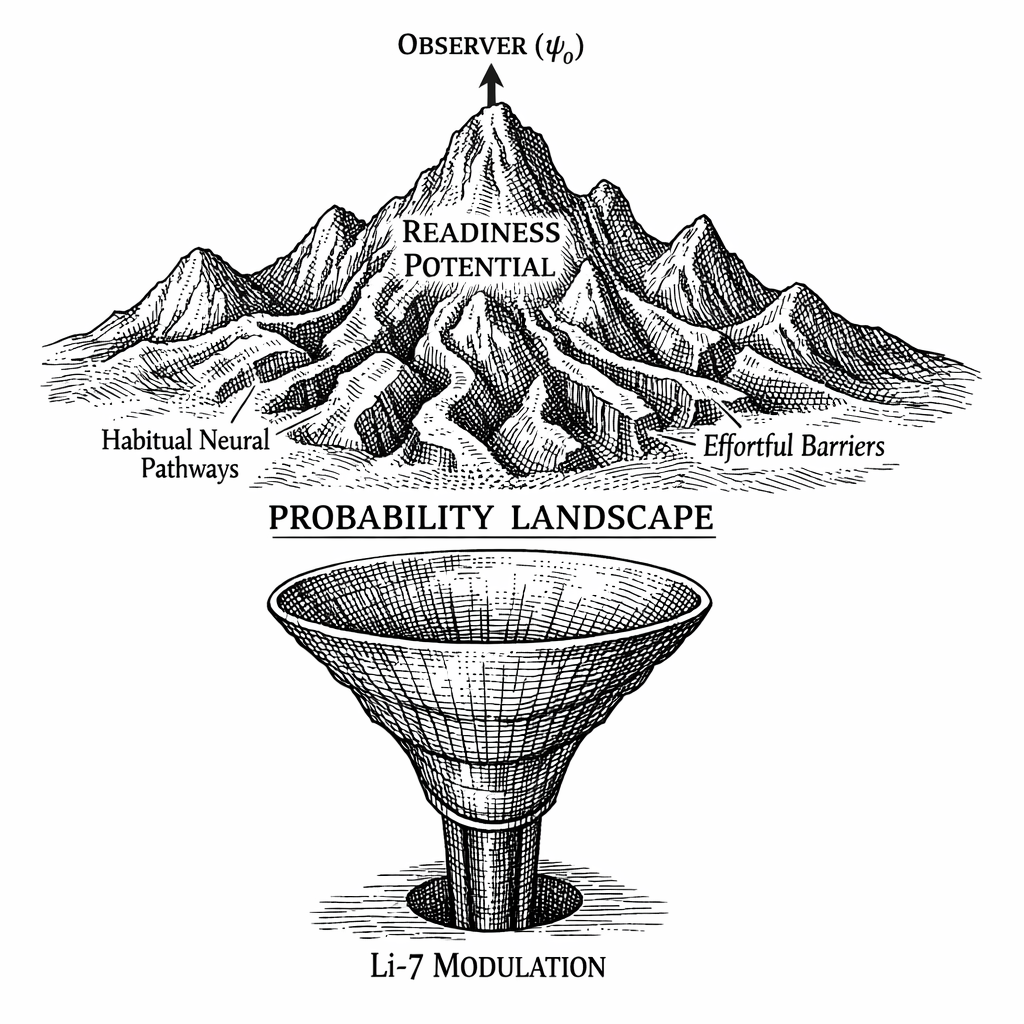
Because the observer cannot generate enough thermodynamic gravity to initiate the collapse, the biological brain defaults to its deterministic programming. The classical brain is a dopamine-seeking optimization system. Without the top-down thermodynamic veto of the conscious observer, it continuously generates Readiness Potentials aimed at immediate rewards. The brain automatically collapses its own wave functions toward paths of least resistance: checking a device, seeking stimulation, or jumping to a novel thought.
The patient's geometric agent is conscious and aware of their intentions, but they are trapped behind a thermodynamic barrier. They attempt to direct their body to perform a task, but the mathematical force of their attention is insufficient to collapse the targeted wave function. The classical machine overpowers the observer.
(This framework aligns with the efficacy of stimulant medications like amphetamines or methylphenidate. By increasing dopamine in the synapses, these medications lower the biological activation energy required for the neurons to fire. This reduced barrier allows the patient's shallower Fisher Information gradient to successfully trigger wave-function collapse, restoring geometric agency.)
17.6 A Profound Reframing of the Human Condition
Translating the tensor calculus of the dimension into the lived reality of psychopathology offers a new framework for clinical empathy.
Historically, interpretations of mental illness have sometimes carried unintended stigma. The experiences of schizophrenic patients have occasionally been dismissed as meaningless chemical misfires. Patients with ADHD are frequently judged as lacking discipline or willpower.
The mathematics of the Semantic Bulk, if correct, reframes these assumptions.
A patient navigating these conditions is a conscious, geometric agent---a pristine point of light in the dimension---who has lost their biological shielding or their thermodynamic leverage.
The patient with Schizophrenia is enduring the unshielded noise of the physical universe bleeding into their quantum antenna. The patient with ADHD is fighting a thermodynamic struggle against the deterministic inertia of classical biology, armed with a geometrically blunted gradient.
Their consciousness is not the disease. Their consciousness is the hostage.
By identifying the quantum boundaries where mind meets brain, DFT provides an architectural blueprint for future treatments. Engineering targeted neuro-pharmacological agents---such as synthesized Lithium-6 isotopes or molecules designed to repair the tensegrity---could stabilize the Decoherence-Free Subspace. Repairing the Faraday cages of the mind could restore the observer's agency. We could give the observer their steering wheel back.
We have explored the baseline of volitional agency, and we have examined the mechanics of its failure.
But what happens when the observer wave function optimizes? What happens when the mind and the machine achieve highly efficient resonance?
How does the Semantic Dimension explain the athletic "Flow State," flashes of scientific insight, and the mathematically unified architecture of Carl Jung's Collective Unconscious?
We turn to Chapter 18 to explore the resonance of genius.
References - Chapter 17:
[1] Fisher, M. P. A. (2015). Quantum cognition: The possibility of processing with nuclear spins in the brain. Annals of Physics, 362, 593-602.
[2] Sechzer, J. A., et al. (1986). The effects of lithium isotopes on the behavior of rats. Biological Psychiatry, 21(13), 1258-1266.
[3] Schizophrenia Working Group of the Psychiatric Genomics Consortium. (2014). Biological insights from 108 schizophrenia-associated genetic loci. Nature, 511(7510), 421-427.
[4] Zurek, W. H. (2003). Decoherence, einselection, and the quantum origins of the classical. Reviews of Modern Physics, 75(3), 715.
Discussion (0)
No comments yet. Start the conversation!