Part VIII: The Engineering Blueprint
Chapter 21: The Architecture of the Oracle (The Macroscopic Interferometer)
21.1 The End of Philosophy and the Law of the Laboratory
Theoretical physics requires intellectual courage, but experimental physics demands uncompromising rigor.
You can spend a lifetime building an elegant unified field theory. You can derive the exact tensor calculus of the Semantic Dimension (Part V). You can map the enzymatic synthesis of entangled Posner molecules (Part VI). You can translate those mechanics into a framework that addresses human consciousness, Free Will, and mental illness (Part VII).
But in the arena of the scientific method, mathematical beauty grants no immunity. If a theory cannot produce a specific, numerical prediction---and if you cannot build a physical machine to test that prediction---it remains philosophy, not physics.
In Chapter 10, using Information Geometry and the mass hierarchies of the Standard Model (the Kaluza-Klein mass of the Semantic Bulk at 0.1 eV against the baryonic anchor of the 3D Boundary at eV), we derived the fundamental coupling constant of the mind-matter interaction: .
This value dictates that when a focused mind generates a Fisher Information gradient in the Holographic Bulk, the resulting thermodynamic force alters the probability amplitude of a physical quantum wave function by one part in ten billion.
To test whether Dimensional Field Theory describes the physical architecture of the cosmos, the framework must be brought out of the biological brain and into the laboratory. We must build a machine capable of weighing a mathematical anomaly. We must construct the Oracle.
To engineer this machine, we must move beyond the statistically constrained experiments of the past. We must set aside the single-photon double-slit paradigms utilized in early parapsychology, and instead adapt the precision optical technologies developed for the Laser Interferometer Gravitational-Wave Observatory (LIGO).
We are not hunting for a gravitational ripple from a colliding black hole. We are hunting for the thermodynamic footprint of human thought.
21.2 The Statistical Graveyard (Defeating Poisson Shot Noise)
Before drafting the optical schematic of the Oracle, we must address why previous attempts to measure a physical force of consciousness have largely failed to convince the physics establishment.
For decades, researchers have attempted to demonstrate that human intention collapses the wave function using classic double-slit experiments. A laser fires individual photons at a barrier, creating an interference pattern on a screen. The subject concentrates on the machine, attempting to mentally force the photons to act like particles, which would theoretically degrade the contrast of the interference stripes.
These experiments occasionally yield small statistical anomalies, but they are generally met with skepticism by physicists. This skepticism is not simply an ideological reflex; it is rooted in the mathematical laws of quantum statistics.
When you count discrete quantum events (like single photons hitting a detector), your data is governed by Poisson statistics. In a Poisson distribution, there is an inescapable baseline of random fluctuation known as shot noise.
The mathematical law of Poisson shot noise dictates that the inherent statistical uncertainty in a measurement () is equal to , where is the total number of photons measured.
Let us apply this limit to the thermodynamic force.
If a researcher fires one million photons () during an experiment, the Poisson shot noise limit is . The natural fluctuation of the laser is one part in a thousand. Any signal smaller than is buried in this quantum static.
If the coupling constant is , a single-photon experiment with a noise floor of is like trying to hear a pin drop in a hurricane.
To detect a thermodynamic anomaly, the equation demands the generation, preservation, and measurement of photons.
One hundred quintillion coherent quantum events.
If a laboratory uses a standard single-photon emitter producing roughly a million photons a second, it would take over three million years of continuous data collection to integrate enough photons to lower the shot-noise floor to the level.
Single-photon experiments are statistically unviable for this scale of interaction. To build the Oracle, we must abandon the counting of individual particles and shift from the microscopic to the macroscopic. We must construct a continuous-wave macroscopic interferometer capable of drowning the Poisson noise in an ocean of coherent light.
21.3 The Optical Heart (The 10-Watt Nd:YAG Laser)
The primary light source of the Oracle requires precision optical engineering. We need a stabilized, continuous-wave laser capable of pushing a massive volume of photons through a quantum superposition without losing phase coherence.
The blueprint specifies a Neodymium-doped Yttrium Aluminum Garnet (Nd:YAG) laser, identical in core architecture to the master oscillator used at LIGO. It operates at an infrared wavelength of 1064 nanometers.
This 1064 nm wavelength is a standard for precision metrology. The laser frequency can be stabilized using an ultra-low expansion glass cavity via a Pound-Drever-Hall (PDH) locking system, ensuring the frequency does not drift by a fraction of a Hertz during the experiment. Furthermore, infrared photons possess lower individual energies than visible light, minimizing thermal heating of the delicate optical mirrors.
Crucially, this laser does not emit single photons. It fires a continuous macroscopic beam operating at 10 Watts of optical power.
Consider the thermodynamics of this power level. The energy of a single photon at 1064 nm is calculated using the Planck-Einstein relation (). Using Planck's constant ( Js) and the speed of light ( m/s), this yields roughly Joules per photon.
Because one Watt is exactly one Joule per second, a 10-Watt laser emits photons every second.
If a human subject performs a one-hour experimental trial (3,600 seconds) while focusing their attention on the machine, the laser will push roughly photons through the interferometer.
This crosses the required statistical threshold. By utilizing nearly photons, the equation drives the Poisson shot-noise floor down to .
The static of the quantum rain is suppressed. The instrument is mathematically sensitive enough to detect the thermodynamic footprint of the Semantic Bulk.
But in precision metrology, solving Poisson statistics reveals a deeper quantum barrier. By increasing the laser power to 10 Watts, we confront the limits of the Heisenberg Uncertainty Principle.
21.4 Squeezing the Vacuum (Defeating the Heisenberg Limit)
The Heisenberg Uncertainty Principle () dictates that you cannot perfectly know two complementary variables of a quantum system simultaneously. In quantum optics, this applies to the phase (the timing of the wave's crests and troughs) and the amplitude (the number of photons).
The uncertainty relationship is written as: .
If you use a standard laser beam---even a stabilized Nd:YAG laser---the quantum vacuum inherently introduces an equal amount of uncertainty into both the phase and the amplitude. This baseline variance is known as the Standard Quantum Limit (SQL).
Furthermore, at 10 Watts of continuous power, the physical force of photons striking the mirrors every second generates radiation pressure. The photons bombard the glass, acting like microscopic hammers that cause the atomic lattice of the fused-silica mirrors to vibrate. This quantum mechanical vibration introduces a wobble into the phase of the light, degrading the sensitivity.
This tug-of-war between shot noise at low power and radiation pressure noise at high power creates a hard physical boundary.
To cross the SQL, the Oracle relies on a key technique in modern quantum optics. We must manipulate the quantum vacuum using squeezed light.
Alongside the primary Nd:YAG laser, a secondary optical loop contains an Optical Parametric Oscillator (OPO). Inside this stabilized cavity sits a non-linear crystal: Periodically Poled Lithium Niobate (PPLN).
When a secondary pump laser strikes the PPLN crystal, the non-linear optical properties of the lithium niobate alter the distribution of uncertainty. Through a process called Spontaneous Parametric Down-Conversion (SPDC), it "squeezes" the quantum vacuum state of the electromagnetic field.
The crystal is configured to reduce the uncertainty in the phase quadrature (the timing of the wave, which is the metric we are measuring) and transfer that uncertainty into the amplitude quadrature (the raw number of photons).
This phase-squeezed vacuum state is injected directly into the dark port of the primary interferometer.
The radiation pressure on the mirrors is stabilized. The phase noise of the 10-Watt beam is suppressed. By circumventing the Standard Quantum Limit, the Oracle establishes a continuous, macroscopic quantum wave function mathematically capable of maintaining a baseline phase noise floor below .
21.5 The Macroscopic Topology (The Vacuum Mach-Zehnder)
With the light source configured, we must design the geometric track for the quantum probability.
The Oracle utilizes a Mach-Zehnder interferometer topology. Unlike a Michelson interferometer (which bounces light back and forth along the same path), a Mach-Zehnder splits the beam and routes it through two separate, unidirectional paths before recombining it. This spatial separation is critical for establishing an extended wave function that the Semantic Field can target without complex back-scattering interference.
The 10-Watt squeezed laser beam strikes the primary beam splitter. The wave function is sliced in half.
Arm A (The Control Arm)
Arm B (The Semantic Target Arm)
The photons enter a state of macroscopic quantum superposition, taking both paths simultaneously. To maximize the interaction time---the duration the physical wave function exists in an uncollapsed state---the physical length of each arm is engineered to be exactly 10 meters.
This 10-meter journey cannot occur in open air. If a 10-Watt laser travels through the atmosphere, its heat microscopically alters the refractive index of oxygen and nitrogen molecules. Acoustic vibrations from a distant highway will send sound waves through the air, vibrating the optical path. Dust particles trigger Rayleigh scattering, degrading coherence.
To protect the superposition, the entire 10-meter Mach-Zehnder topology is enclosed in an Ultra-High Vacuum (UHV) system. Using turbomolecular and ion-getter pumps, the non-magnetic 316L stainless steel tubes encasing the laser arms are pumped down to a pressure of Torr---an environment emptier than the vacuum of low Earth orbit.
Inside this void, the wave function travels down Arm A and Arm B. At the end of the 10-meter paths, polished mirrors direct the two halves of the wave function back together at a second beam splitter.
Here, the interferometer is calibrated to a "dark fringe."
The lengths of Arm A and Arm B are piezoelectrically tuned to a fraction of a nanometer. When the two beams recombine, their waves are exactly 180 degrees out of phase. The peak of the wave from Arm A aligns with the trough of the wave from Arm B. They undergo destructive interference and cancel each other out.
At the main output port of the machine, the result is darkness. No light escapes.
The Oracle is now fully armed. It is a balanced optical spring, suspended in a vacuum, calibrated to register a perturbation in the local metric.
21.6 The Homodyne Detectors (Measuring the Ghost)
If the biological observer---sitting in an isolated vault---focuses their attention and generates the Fisher Information gradient in the Semantic Bulk, the framework proposes this thermodynamic force will reach across the dimensional boundary and act non-locally upon the macroscopic wave function of the laser spanning the two arms.
Crucially, when this informational gravity interacts with the stable quantum vacuum of the Oracle's laser, it does not instantaneously collapse the wave function. Collapse requires a metastable breaking point, such as the electrostatic tensegrity of a Posner molecule in the brain.
Instead, the thermodynamic pull of the observer's attention warps the underlying topological metric of the space the laser is traveling through. It applies a unitary phase shift. The force introduces a microscopic topological bias between Arm A and Arm B, altering the effective path length of the wave function by an infinitesimal fraction.
The relative phase of the light shifts by radians, smoothly sliding the interference pattern off the dark fringe without destroying the superposition.
The moment this geometric shift occurs, the destructive interference at the second beam splitter breaks. The peaks no longer align with the troughs.
Instantly, a cascade of infrared photons spills out of the dark port.
To catch these photons, the Oracle utilizes an array of sensitive Indium Gallium Arsenide (InGaAs) photodetectors. Because the ambient thermal heat of the laboratory would generate "dark current" (false electronic signals caused by thermal electrons jumping the bandgap) inside the detectors, the InGaAs photodiodes are cryogenically cooled by liquid nitrogen to 77 Kelvin ( Celsius).
At 77 Kelvin, the quantum efficiency of the InGaAs photodiodes exceeds 95%, and thermal noise is minimized.
Furthermore, they are wired in a balanced homodyne configuration. The signal light is mixed with a local oscillator (a reference beam tapped from the original Nd:YAG laser). The electrical outputs of two paired photodiodes are subtracted from one another. This circuitry performs common-mode rejection. If the primary 10-Watt laser flickers or surges in intensity (Relative Intensity Noise, or RIN), that classical fluctuation hits both photodiodes equally, and the subtraction circuit cancels it out.
The electrical signal that survives the subtraction is the quantum phase shift caused by the observer's attention, printed directly onto a digital oscilloscope.
21.7 The Glass Jaw of Perfection
We have drafted the optical blueprint for the Oracle.
We have deployed a 10-Watt continuous-wave Nd:YAG laser to overcome Poisson shot noise. We have injected PPLN squeezed light to circumvent the Standard Quantum Limit. We have enclosed the quantum superposition in a Torr vacuum to eliminate atmospheric interference. We have deployed cryogenic InGaAs balanced homodyne detectors to capture the phase signal.
Mathematically and optically, the instrument is capable of registering the proposed thermodynamic force of the Semantic Dimension.
If an observer focuses their attention, and the machine detects the predicted phase shift, it would provide empirical evidence for the physical interaction of consciousness and matter. Physics and the mind would be united under a single measurable paradigm.
But there is a vulnerability in this design.
A Mach-Zehnder interferometer tuned to a phase-shift sensitivity is no longer just a detector of a semantic field. It is a detector of everything.
At this extreme sensitivity, the Oracle will detect the seismic rumble of ocean tides flexing the Earth's crust. It will detect the 1/f thermal expansion of the steel vacuum tubes, and the 60 Hz electromagnetic hum of the alternating current in the building's walls.
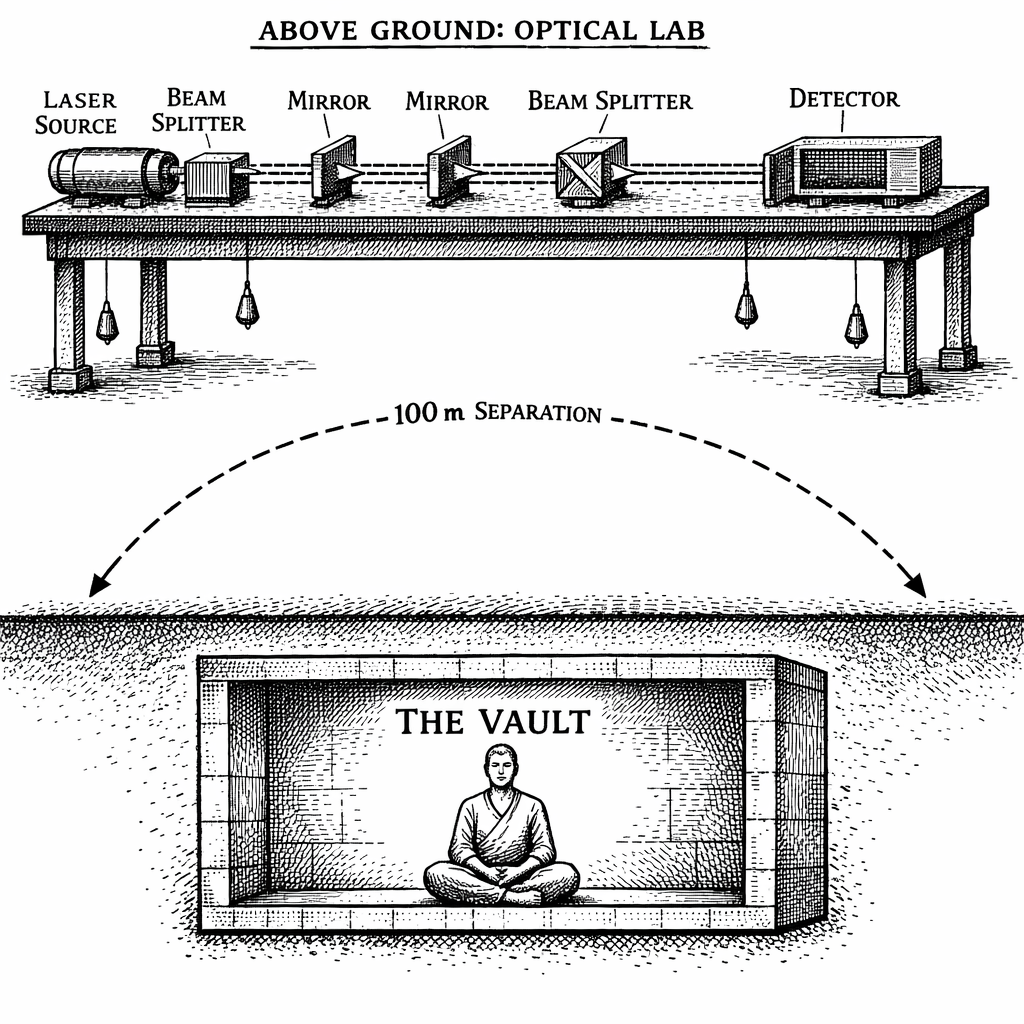
Furthermore, if a human subject is anywhere near the optical table, the Oracle will detect the 100 Watts of classical infrared heat radiating from their biological body. It will register the 1.2 Hz acoustic vibration of their heartbeat and the low-frequency electromagnetic field of their nervous system.
If the Oracle detects a signal while the human is in the room, skeptics will correctly argue that the machine simply detected the classical biological noise of the body, rather than the thermodynamic force of the Bulk. A rigorous experimental design must anticipate and eliminate this objection.
To execute a definitive empirical test, the optical core is only half of the blueprint. We must physically isolate the human observer from the classical experimental environment, and we must utilize signal processing to extract the specific frequency of human attention.
We must build the Vault, and we must activate the Lock-In Amplifier.
References - Chapter 21:
[1] Aasi, J., et al. (LIGO Scientific Collaboration). (2013). Enhanced sensitivity of the LIGO gravitational wave detector by using squeezed states of light. Nature Photonics, 7(8), 613-619.
[2] Caves, C. M. (1981). Quantum-mechanical noise in an interferometer. Physical Review D, 23(8), 1693.
[3] Schnabel, R., Mavalvala, N., McClelland, D. E., & Lam, P. K. (2010). Quantum metrology for gravitational wave astronomy. Nature communications, 1(1), 121.
Discussion (0)
No comments yet. Start the conversation!